Reading Notes: Latent Chain-of-Thought and Recurrent Computation
These are reading notes from July 2025 on latent chain-of-thought surveys and recurrent approaches. They reflect the papers and terminology available at the time.
Reasoning Beyond Language: A Comprehensive Survey on Latent Chain-of-Thought Reasoning
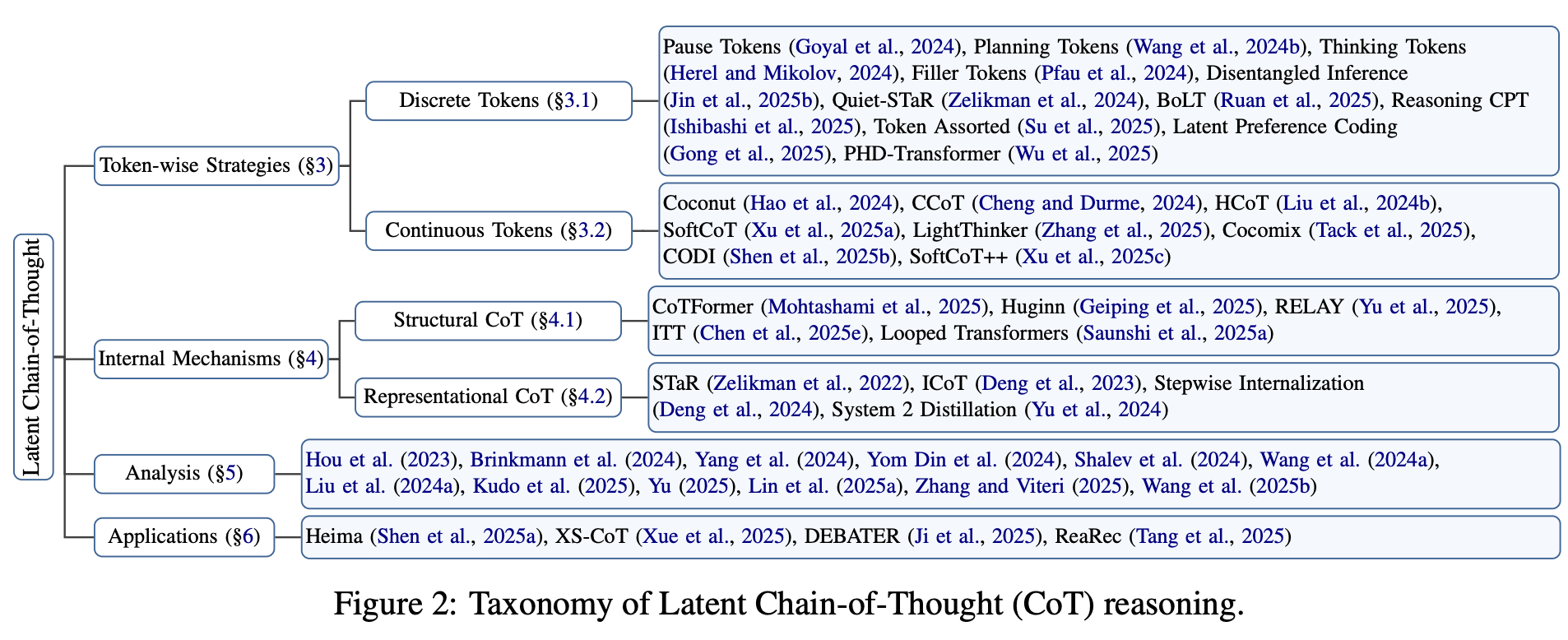
Taxonomy
- methodological advances
- token-wise strategies
- discrete tokens
- continuous tokens
- Internal mechanisms
- structural forms
- representational forms
- token-wise strategies
- analysis and interpretability
- applications
Token-wise strategies
Discrete tokens
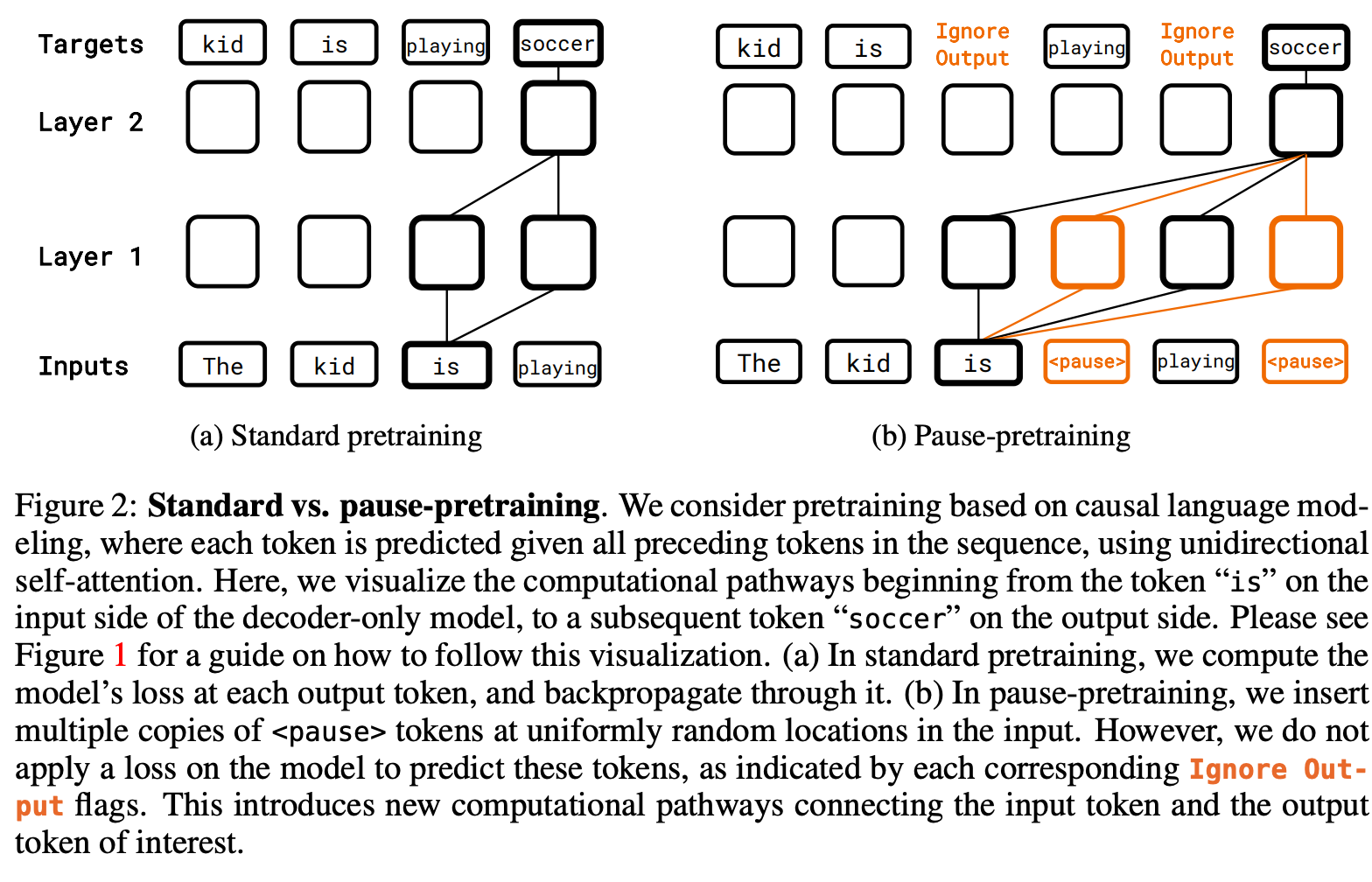
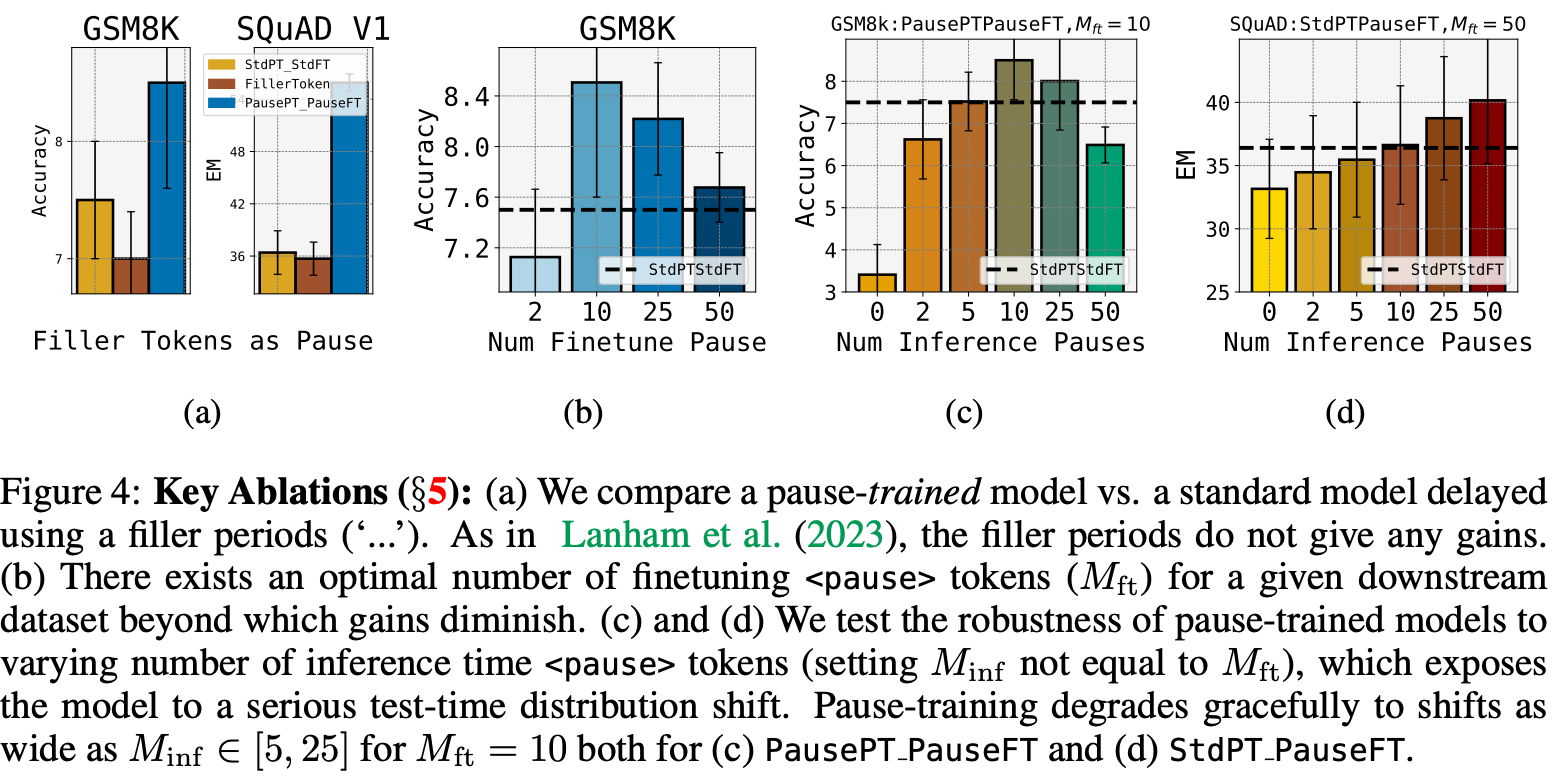
- Pause Tokens (Goyal et al., ICLR 2024)
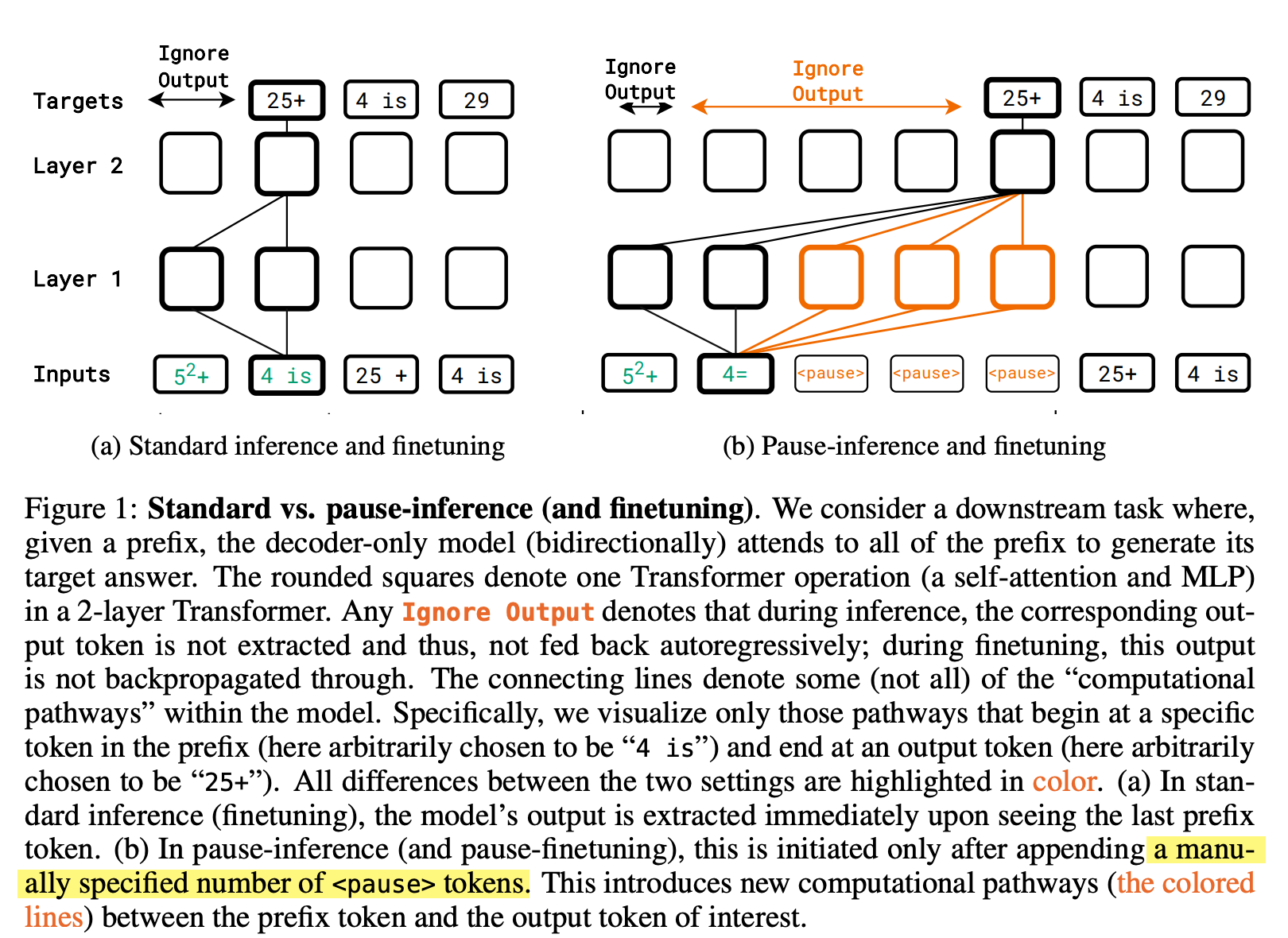
- pretraining: 在文本中随机插入pause token,不算pause token上的loss
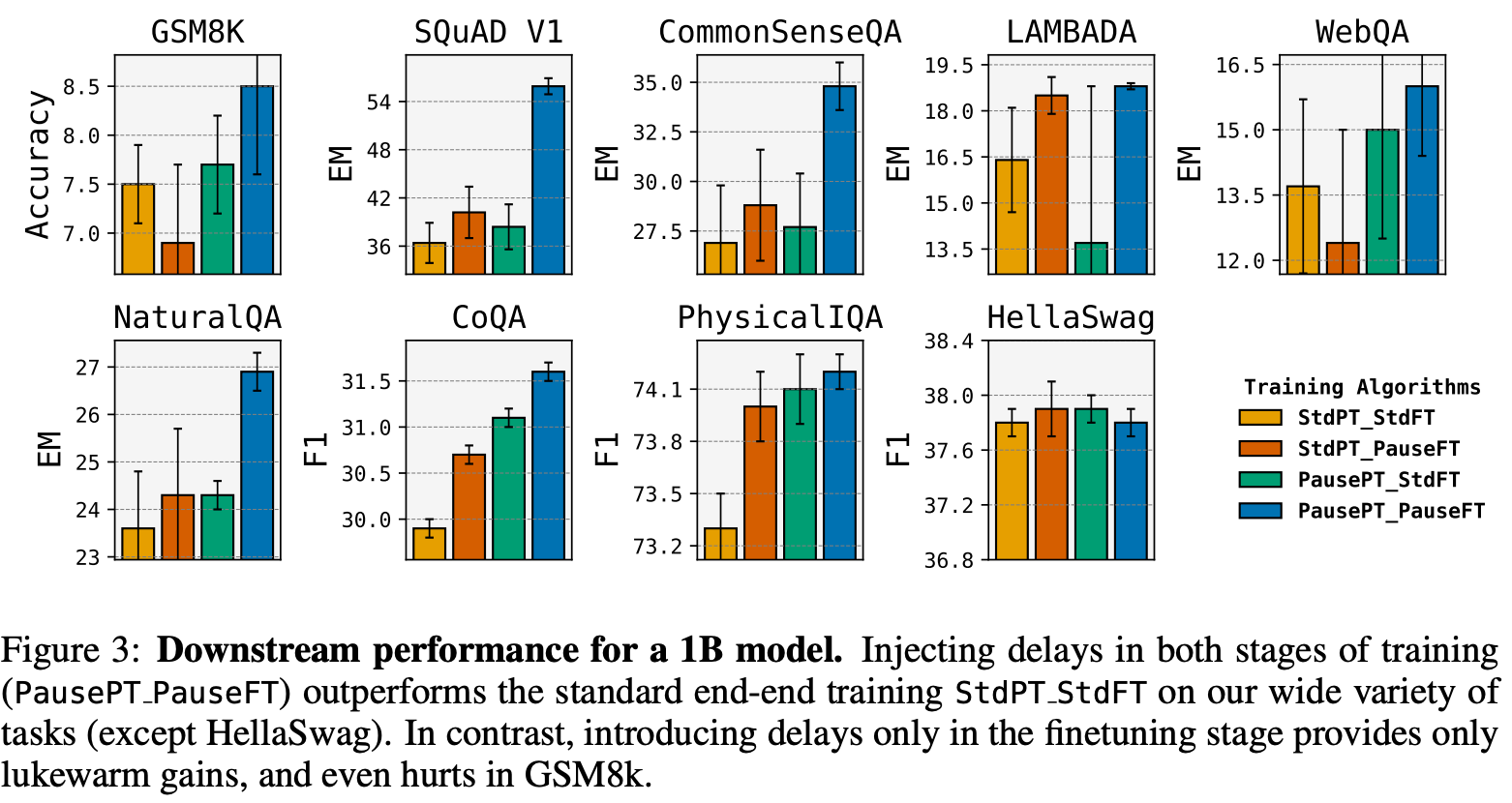
- ablations: 在finetune的时候加多少pause token是认为给定的,这里对这个数量做了ablation (figure 4b);figure 4c中表示出训M个pause token,在inference中略微改变pause个数,性能不会差太远
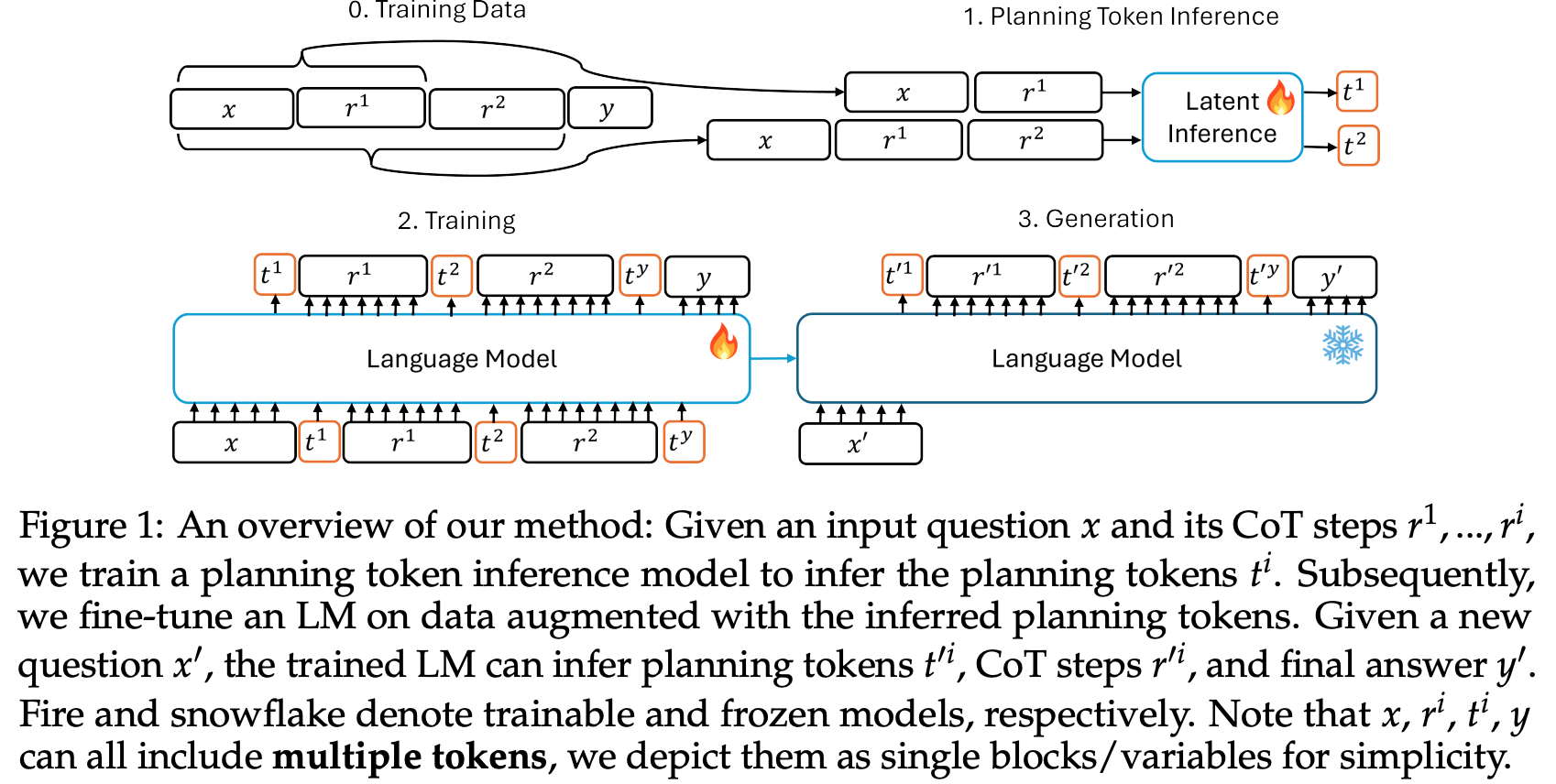
- Planning Tokens (Wang et al., 2024),
- the token embedding that can be dynamically captured instead of manually assigned
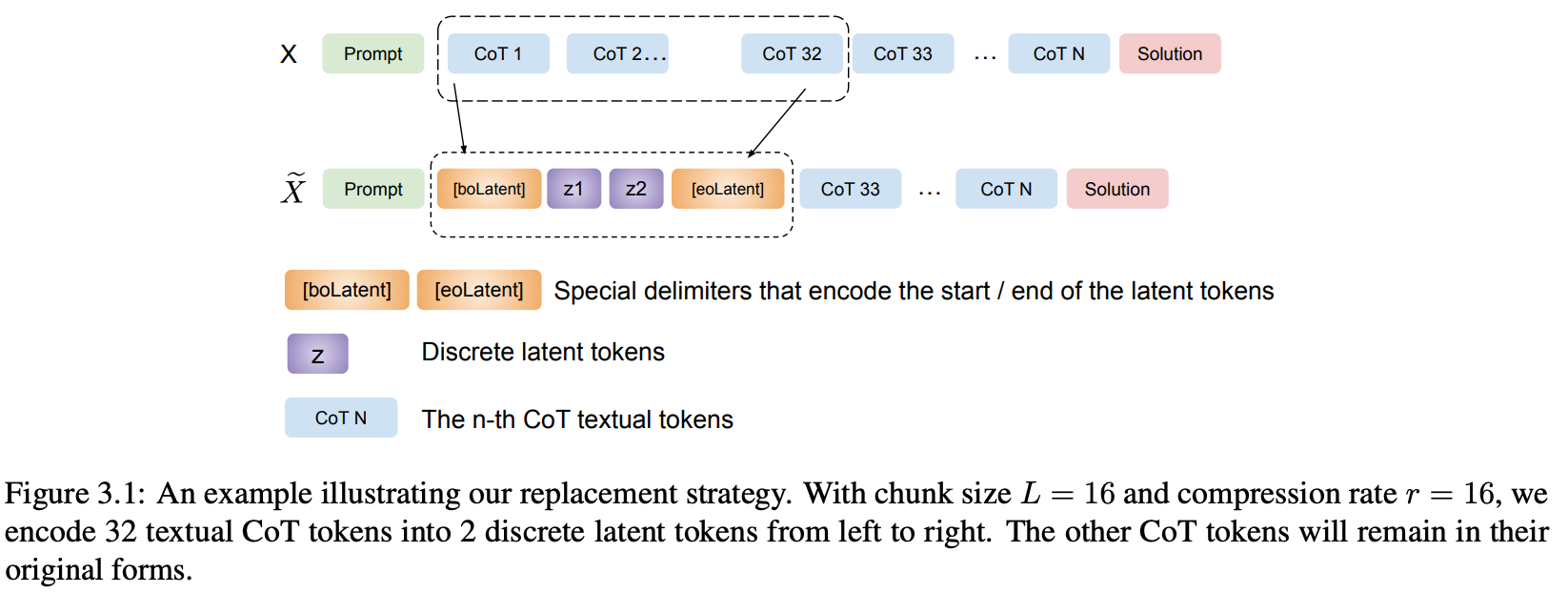
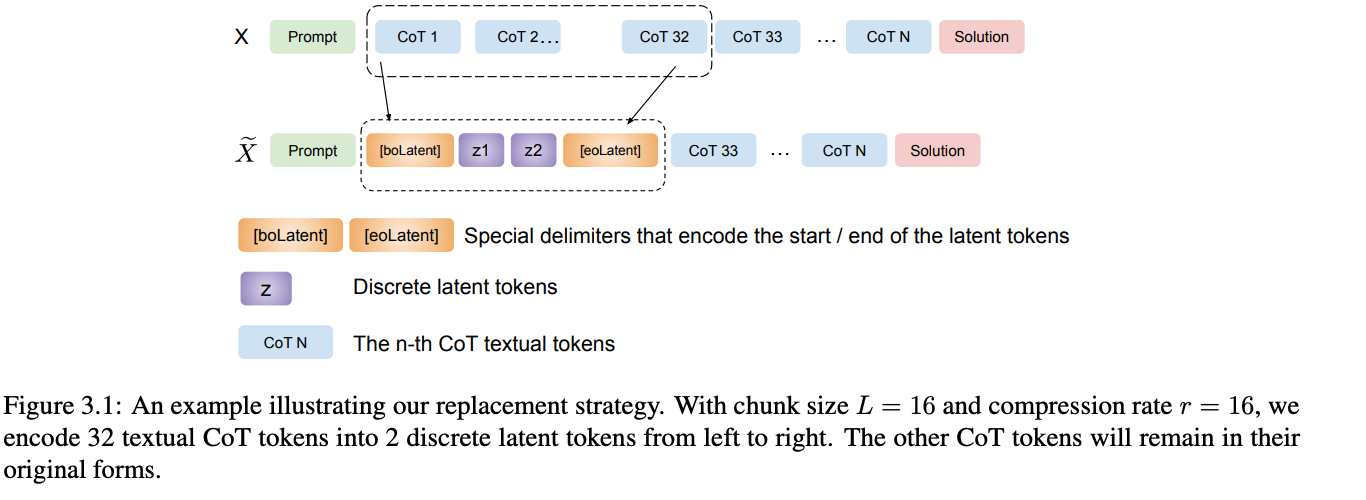
- Token Assorted (Su et al., 2025)
- employed vector-quantized VAEs (VQ-VAEs) to condense reasoning steps into discrete latent tokens, reducing computational costs while maintaining performance.
Continuous tokens
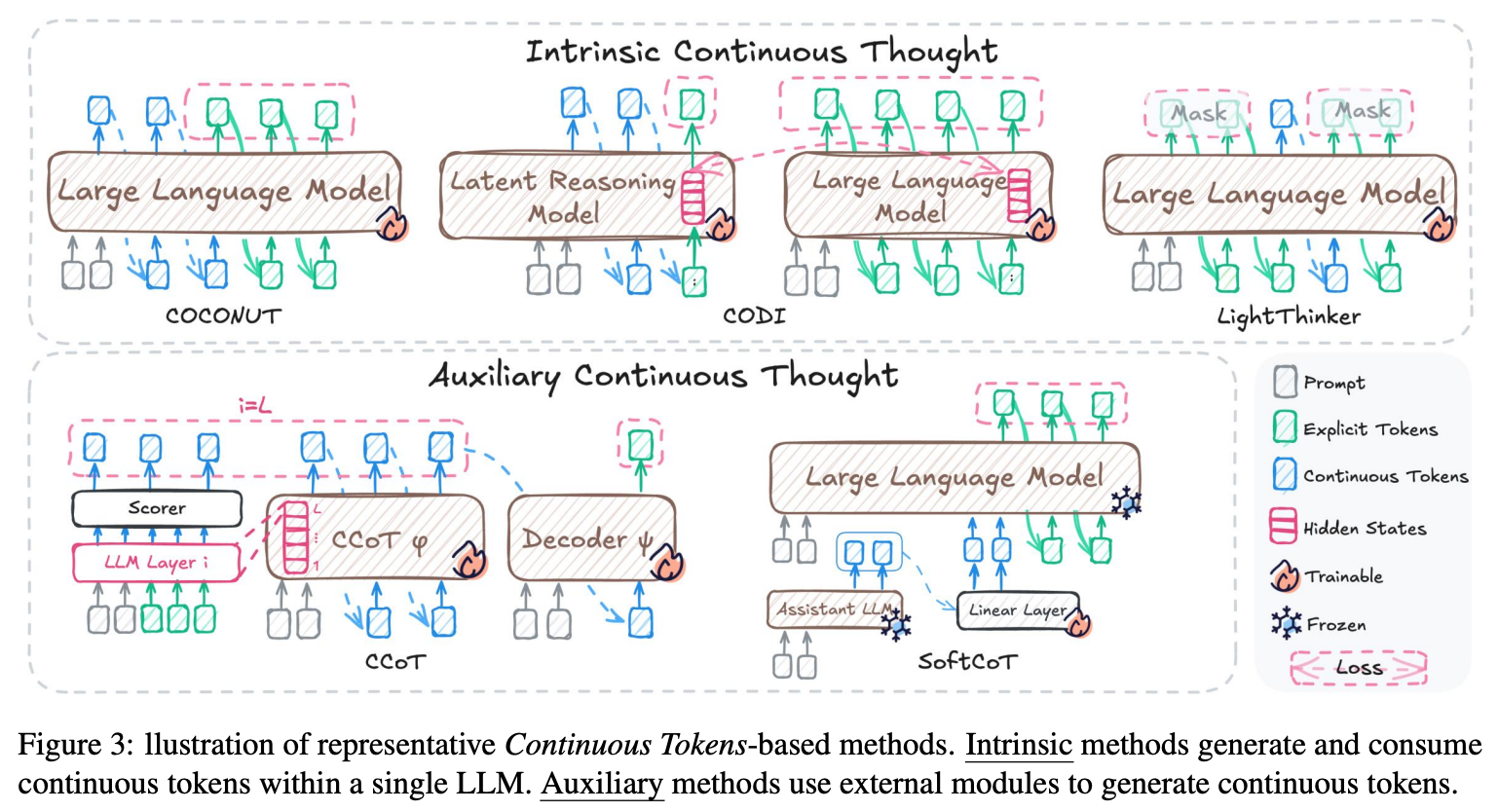
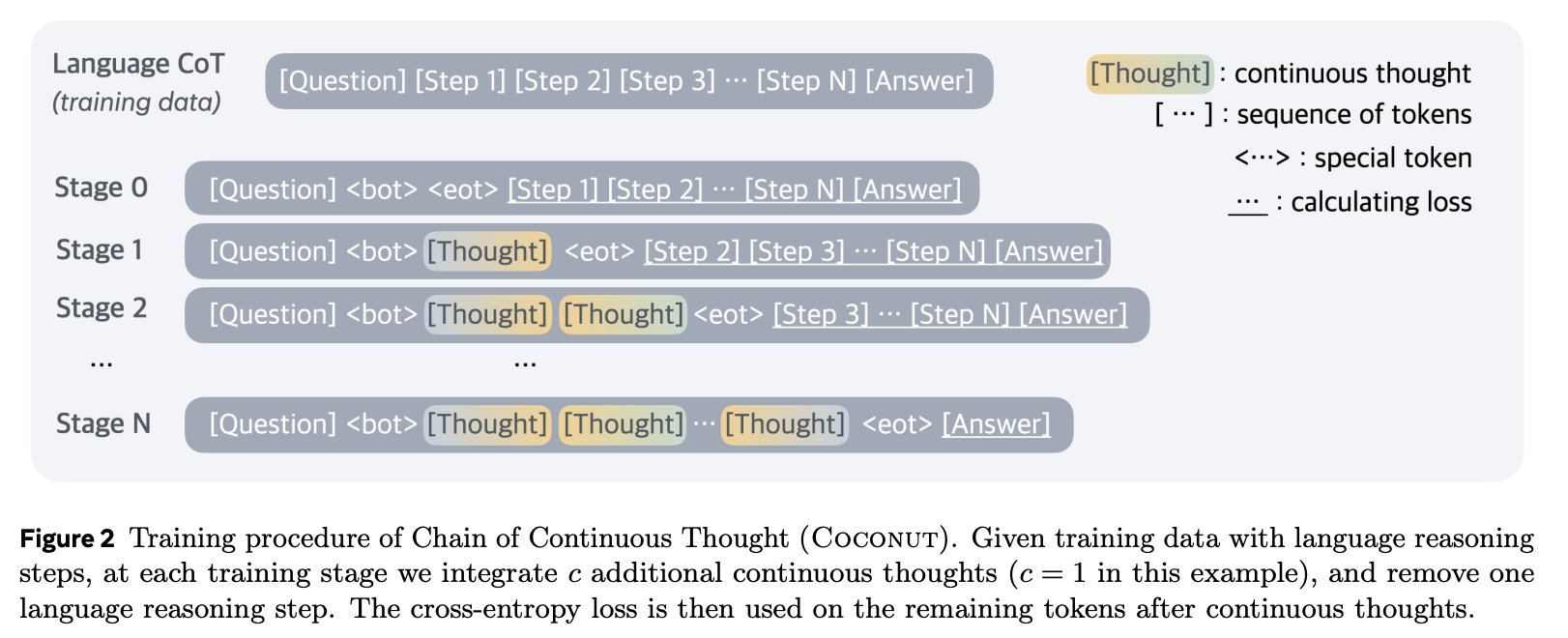
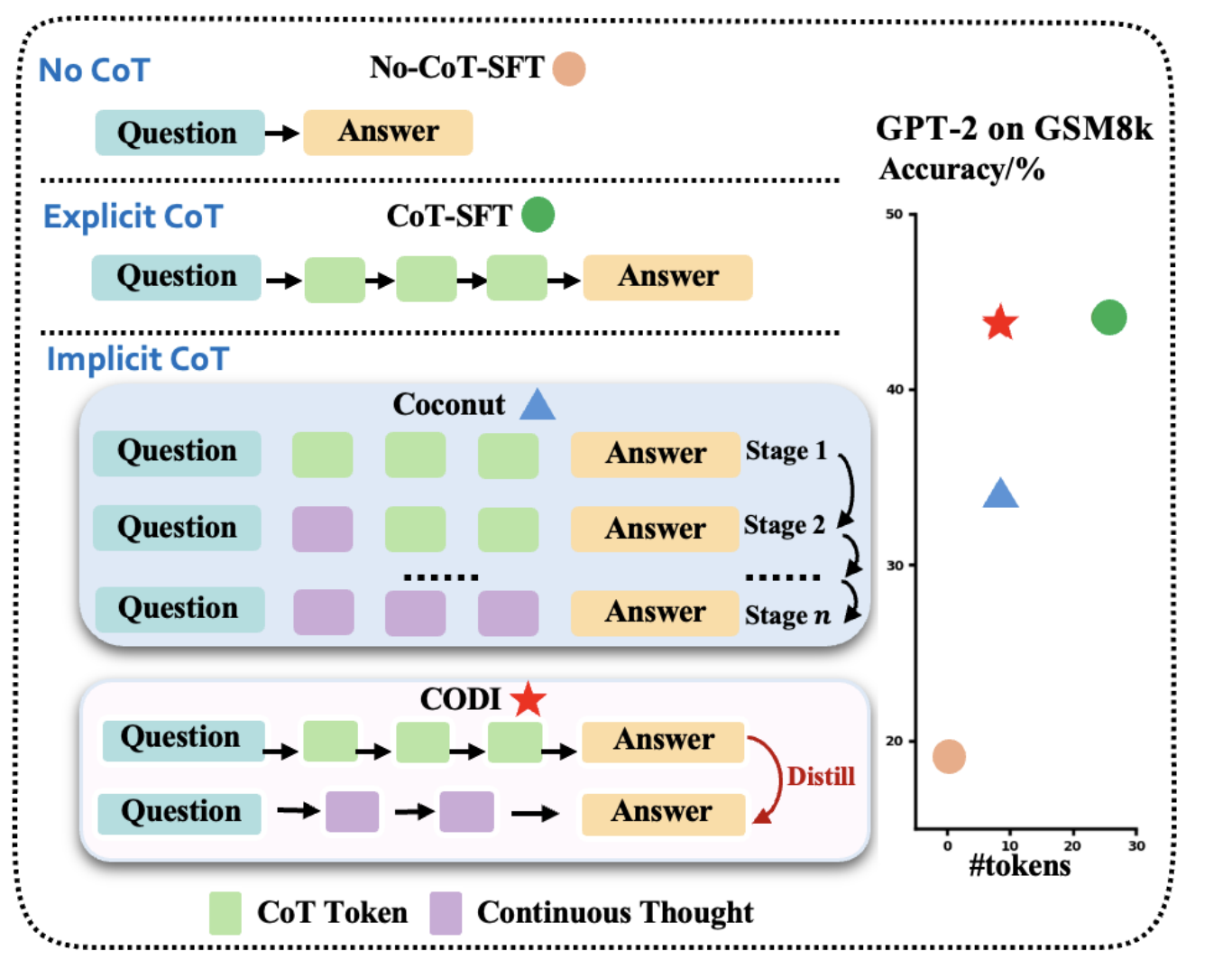
- COCONUT
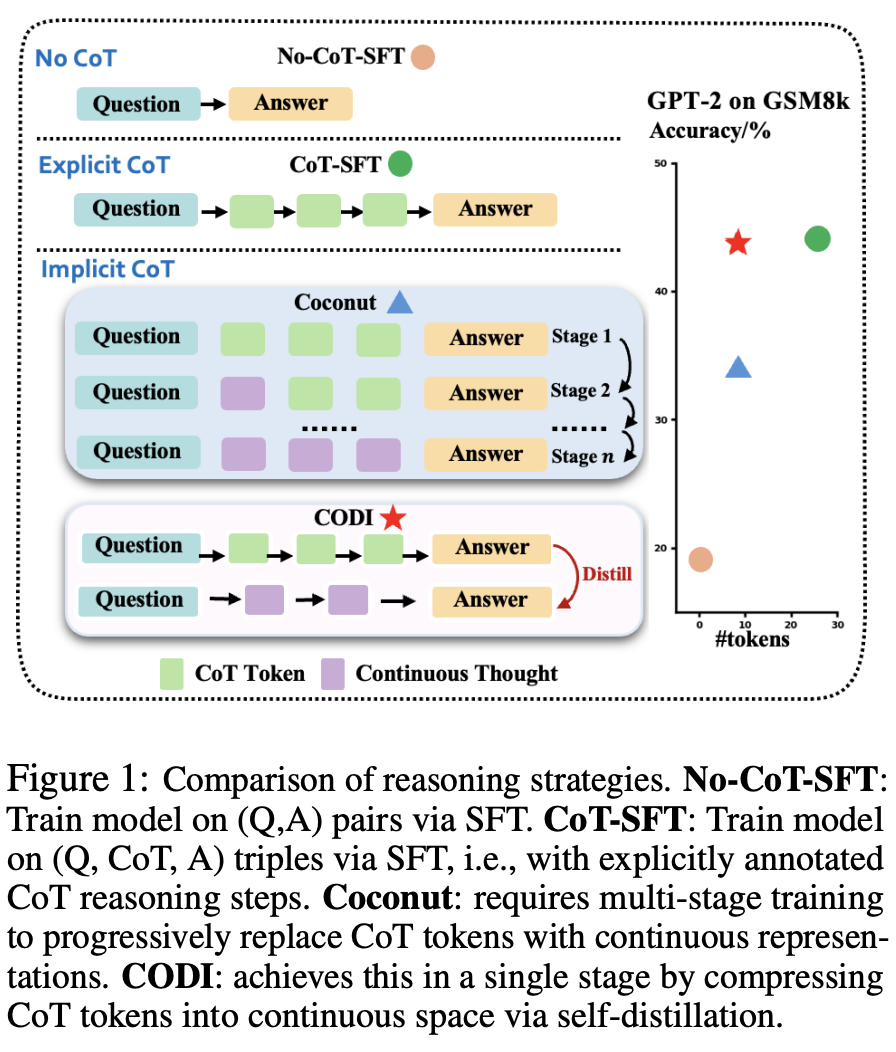
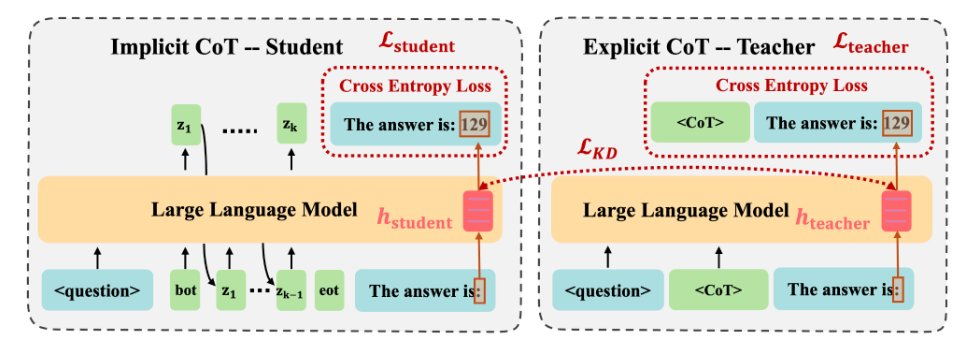
- CODI
A Survey on Latent Reasoning
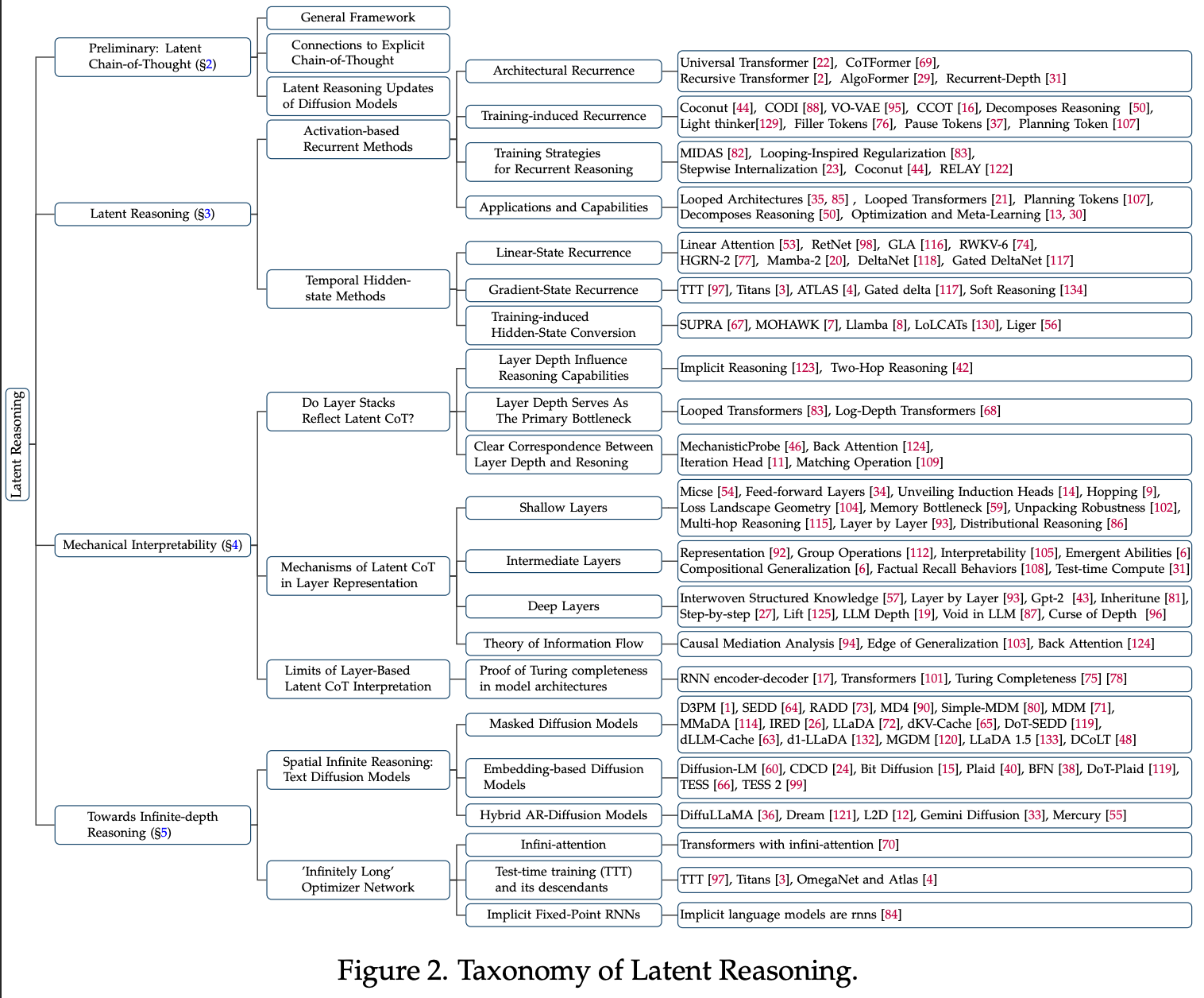
Latent Reasoning
作者总体分为vertical recurrence: activation-based methods和horizontal recurrence: hidden state-based methods
1. Activation-based Recurrent Method
1.1 Loop/Universal Transformer Recurrence
Loop/Universal transformer recurrence:通过architecture上的改动,使得一次前向可以包含多层的recurrence。
- initial work
- universal transformer (2018)
- 有一个机制控制循环几次
- Adaptive Computation Time to control compute step for each token independently $\Rightarrow$ 每个position的ACT是独立的,如果某个position a在t时刻被停止了,$h_a^t$会被一直复制到最后一个position停止
- The key innovation lies in treating network depth not as a static hyperparameter but as a dynamic computational resource that can be allocated based on task complexity
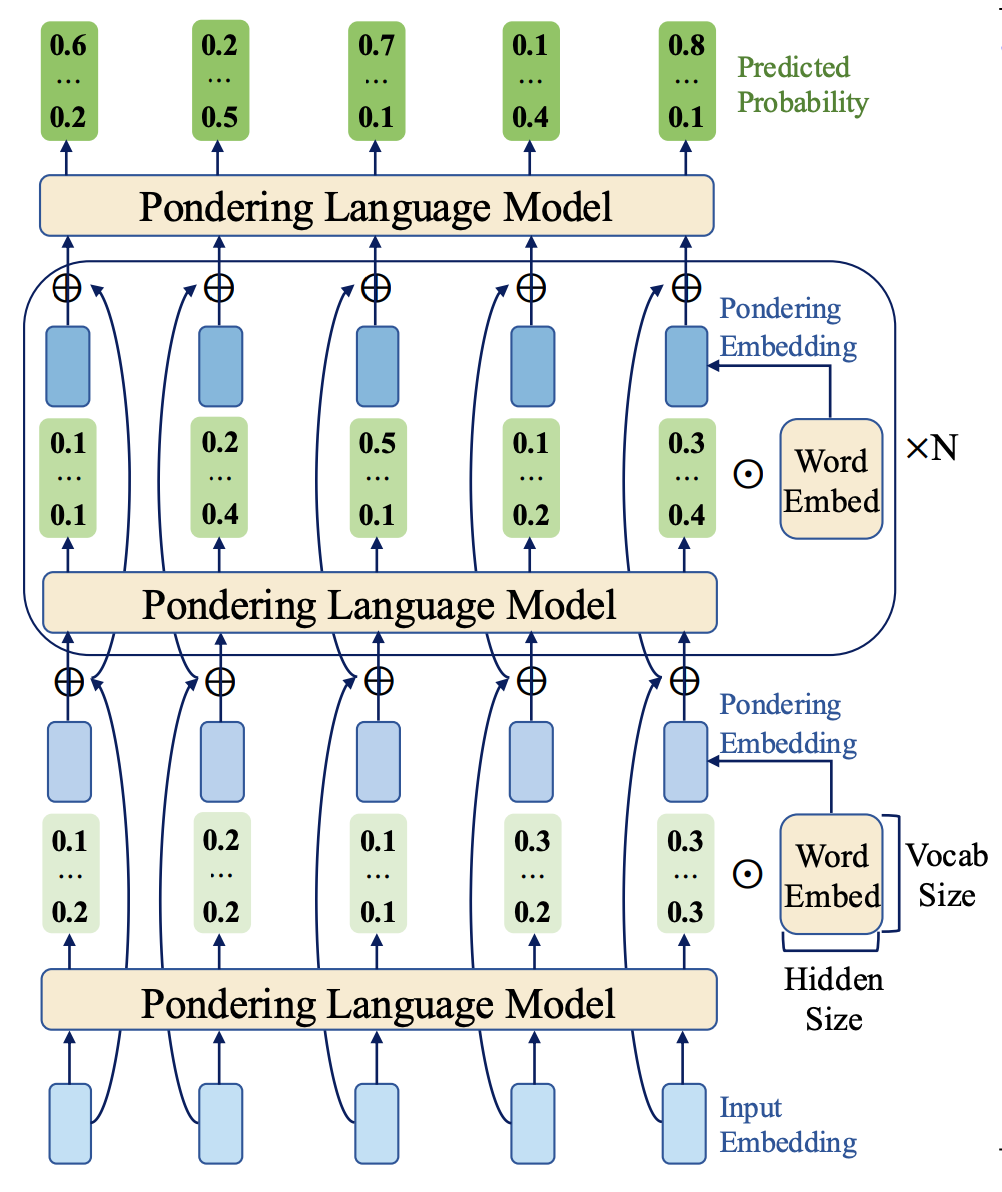
- Pondering LM (2025.6)
- 有点像Jacobi decoding
- 一次前向,用输出的probability对token embedding加权,作为下一轮输入,再迭代几轮
- universal transformer (2018)
- some evolution trend
- 逐渐模块化:The Rise of Pre/Loop/Coda Structure
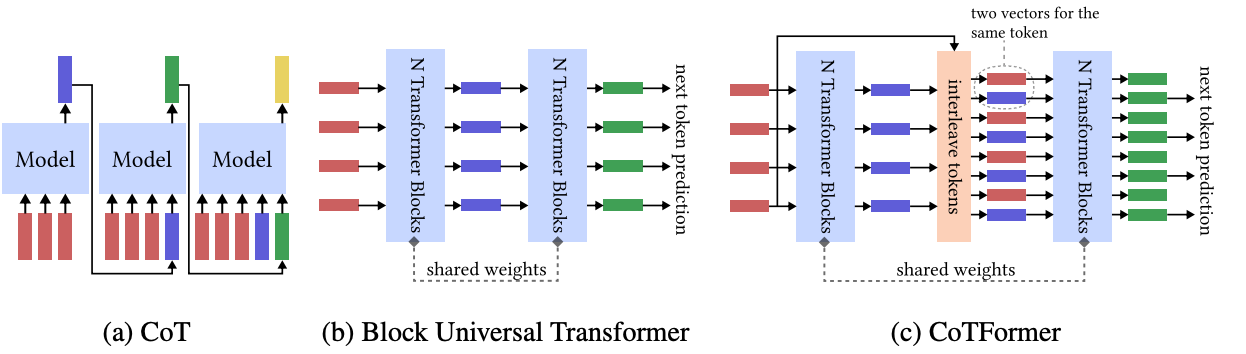
- Universal Transformer and CoTFormer 没有特别的stage的区分,都是统一的recurrent的架构
- CoTFormer:把之前的token append直接append到输出token前(2 vectors for a same token)
- CoTFormer:把之前的token append直接append到输出token前(2 vectors for a same token)
- 之后逐渐区分出Pre/Loop/Coda的structure
- Universal Transformer and CoTFormer 没有特别的stage的区分,都是统一的recurrent的架构
- 每个模型中per-iteration的input会有区别:
- 给上一层的output
- 给上一层的output+depth embeddng(Universal Transformer)
- 给上一层的output和第一层的embedding
- depth embedding逐渐消退
- dynamic stopping机制逐渐简化
- 从一开始universal transformer的ACT(算cumulative probability)到CoTFormer的MoR router,之后基本类似于不动点迭代
- 逐渐模块化:The Rise of Pre/Loop/Coda Structure
1.2 Activation with Explicit Hidden-State Feedback
While loop-based architectures refine token representations by rerunning the same set of layers, a distinct family of models feeds hidden states back into the input stream between iterations.
In these systems the hidden activations themselves become new sequence elements, so each recurrent step simultaneously extends the effective depth and exposes internal computation to subsequent attention.
- COCONUT
- CoTFormer
和上面的Universal Transformer的不同之处:
- 会重新把hidden vector当作token输进去(sequence随着每次过前向会变长), bridging vertical recurrence and horizontal memory
- no architectural expansion—the model reuses the same layers so parameter count stays constant while depth grows dynamically
- latent reasoning remains internal, thereby avoiding the latency of producing explicit CoT tokens
1.3 Training-induced Recurrence
不用做architectural改进
- core principal: create implicit loops in the computation graph
- continuous recurrence: 把activation重新喂给模型,by feeding activations back into the model
- compressed states: compressing multi-step reasoning into iteratively-processed representations
- expanded iterations: extending the effective computation depth through strategic token insertion
⭐️ the differences between architectural changes like universal transformer and adding latent tokens:
-
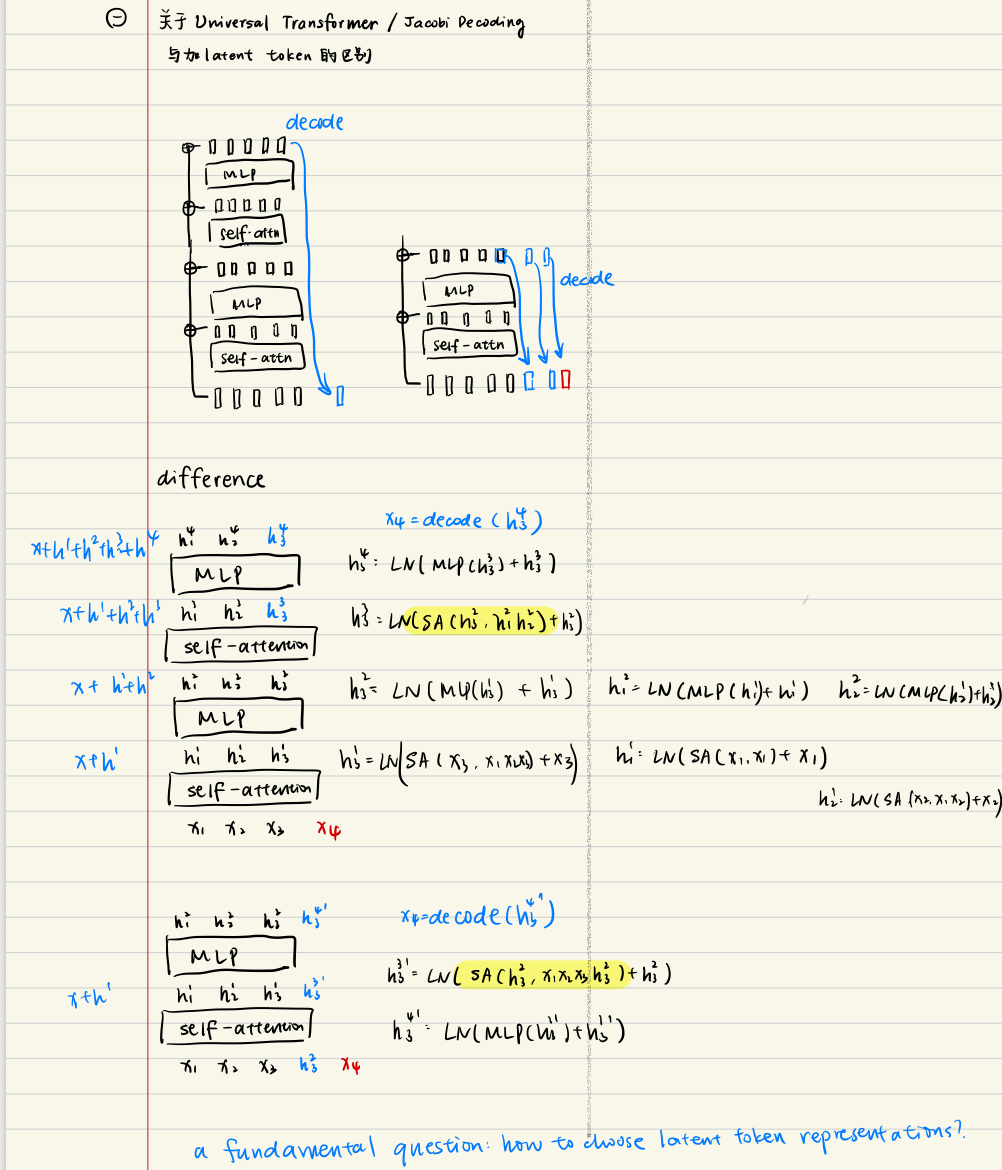 这么看来,从表达能力上来看,上面这种universal transformer的要比加latent token的要好,因为$h_1^2, h_2^2$包含了$x_1, x_2$的信息(through residual stream)。但效率上应该要低一些?
- Continuous Activation Recurrence
- Coconut: implemented entirely through training, instead of modifying the model architecture.
-
trainig process
- at the $k$-stage, the first $k$ reasoning steps in the CoT are replaced with $k\times c$ continuous thoughts, where $c$ is a hyperparameter controlling the number of latent thoughts replacing a single language reasoning step
- does not encourage the continuous thought to compress the removed language thought, but rather to facilitate the prediction of future reasoning
-
inference process
- train a binary classifier on latent thoughts to enable the model to autonomously decide when to terminate the latent reasoning
- always pad the latent thoughts to a constant length
- ⭐️ 这里直觉上来说,是否可以用不动点迭代思想,用latent thought是否收敛来判断
-
- CoCoMix: Coconut 续作
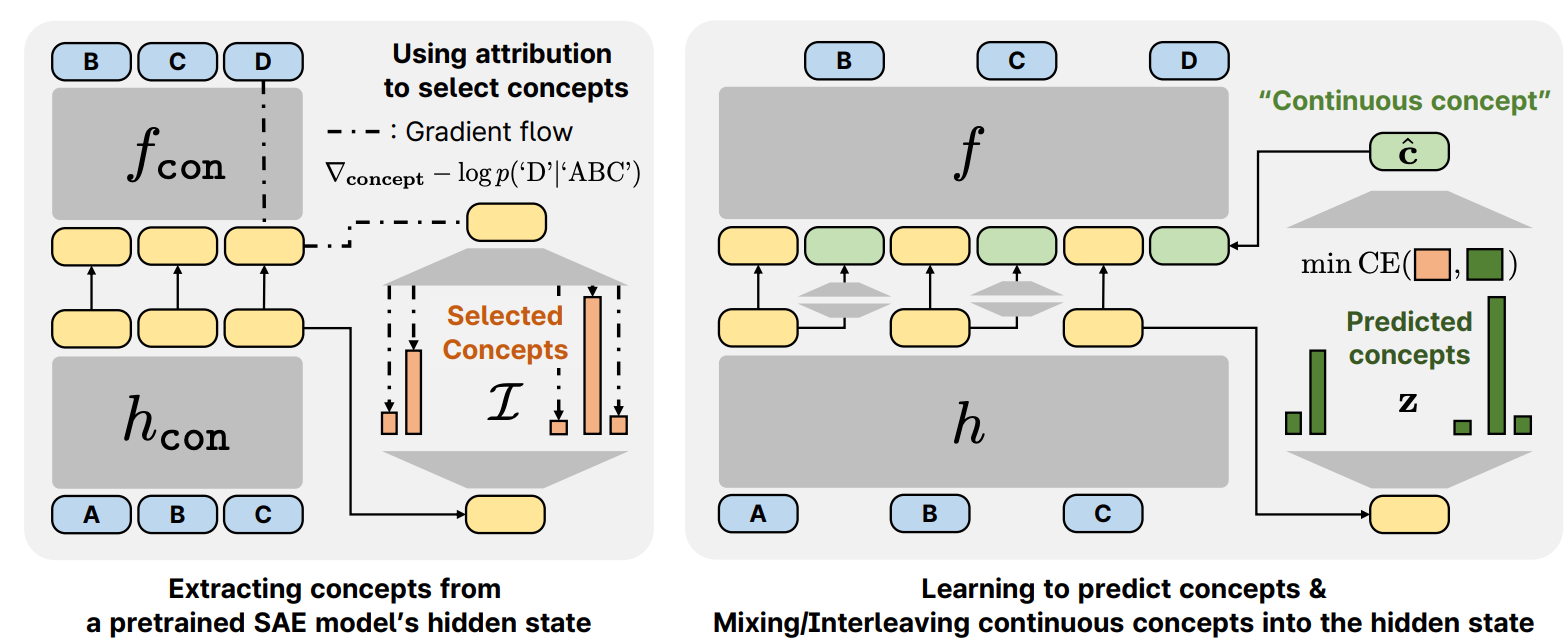
- 用一个预训练的SAE来抽每一次前向中的influential concepts based on attribution scores
- the model is then trained to predict these selected concepts from its hidden state using a cross entropy loss
- model 能够 predict multiple concepts后,可以把这些压缩到一个single continuous concept然后mix or insert到hidden states中去
- can do steering with the concepts
- CODI: self distillation
- By aligning the hidden activation before the final answer between teacher (with full CoT) and student (with compressed reasoning) paths, CODI effectively learns a fixed-point iteration in activation space.
- more stable than coconut’s curriculum learning
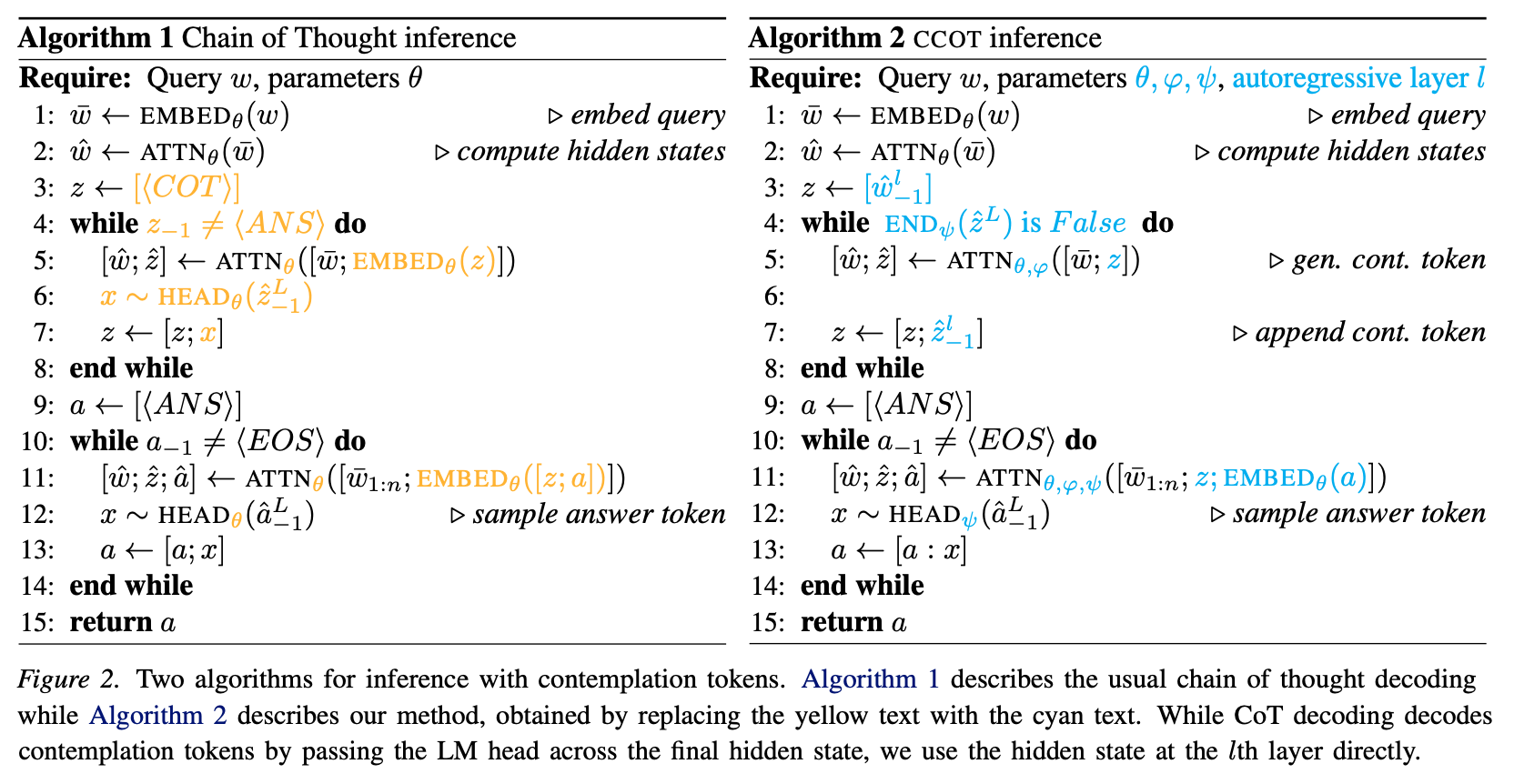
- CCOT: variable lengths
- PCCOT: Jacobi-iteration allowing parallel continuous thoughts
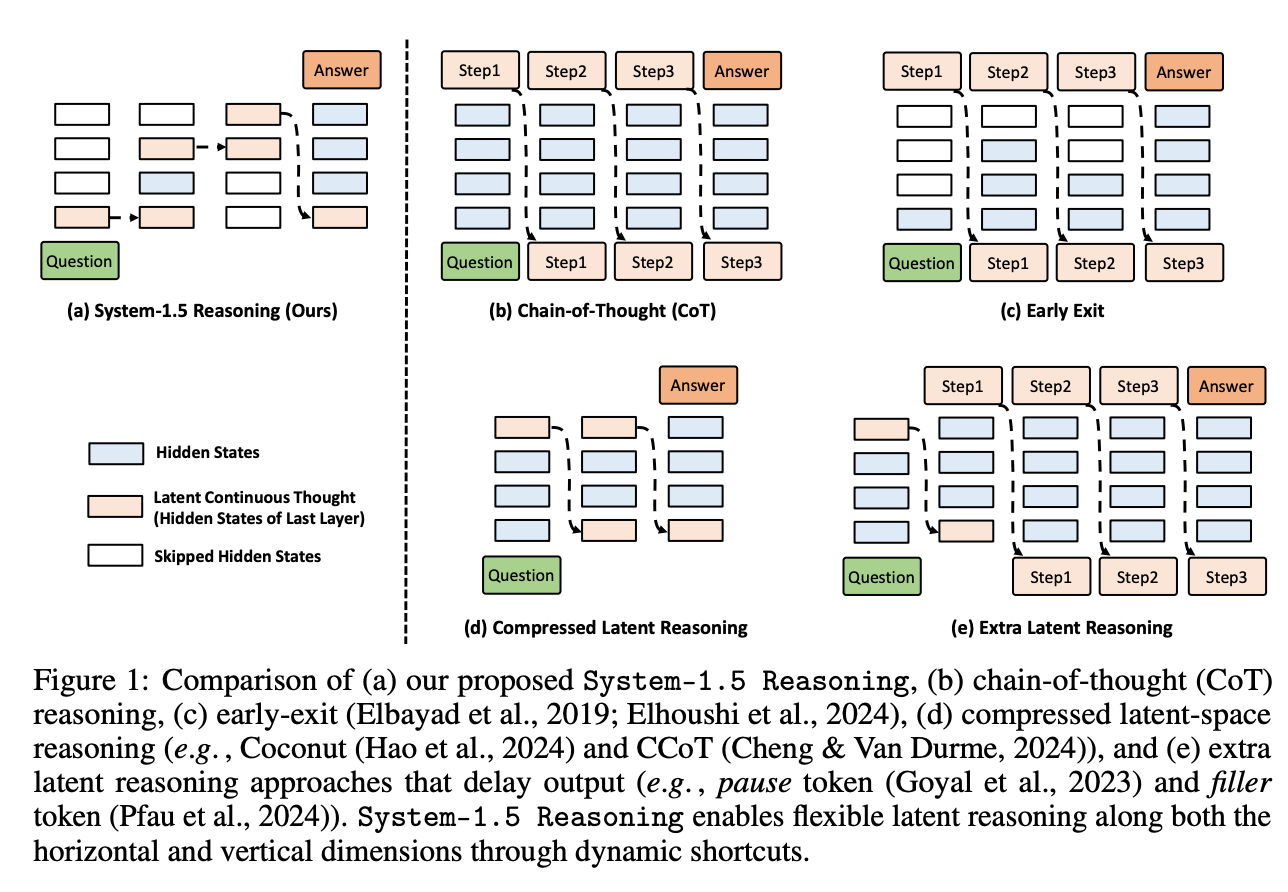
- System-1.5 Reasoning
- 不止省token,也省层深的latent reasoning
- Coconut: implemented entirely through training, instead of modifying the model architecture.
- Compressed State Recurrence: compress reasoning steps into discrete / semi-discrete tokens
- Token Assorted
- gist tokens
- Token Assorted
- Iteration Expansion through Strategic Tokens
- Filler Token: Pfau et al. demonstrate that even meaningless filler tokens (e.g., “……”)
- Pause Token: Goyal et al. refine this with learnable
<pause>tokens that explicitly signal computation steps - More sophisticated approaches inject structured tokens that organize the recurrence pattern,比如加入类似:
<memory>,<reason>
1.4 Training Strategies for Recurrent Reasoning
- for architectural recurrence
- MIDAS proposes a progressive stacking framework to address training stability in loop-based models. It defines a replication operator $M(f, b)$ that duplicates the middle layers of a base model $f$ by a factor $b$, enabling gradual depth expansion.
- for training-induced recurrence
- Stepwise Internalization pioneered curriculum-based compression of reasoning traces. This technique gradually removes CoT tokens during finetuning, allowing models to internalize reasoning patterns into their parameters. $\Rightarrow$ curriculum learning adopted by Coconut
Enjoy Reading This Article?
Here are some more articles you might like to read next: