Reading Notes: Latent Reasoning and Reinforcement Learning
A selection of paper notes from July and August 2025, covering latent-space adaptation, reinforcement learning, and compressed reasoning.
Seek in the Dark: Reasoning via Test-Time Instance-Level Policy Gradient in Latent Space
2025.5.19 BIGAI, Zilong
- LATENTSEEK leverages policy gradient to iteratively update latent representations, guided by self-generated reward signal
- Test-Time Instance-Level Adaptation (TTIA) does not require parameter updating and operates on a per-instance basis during the testing phase
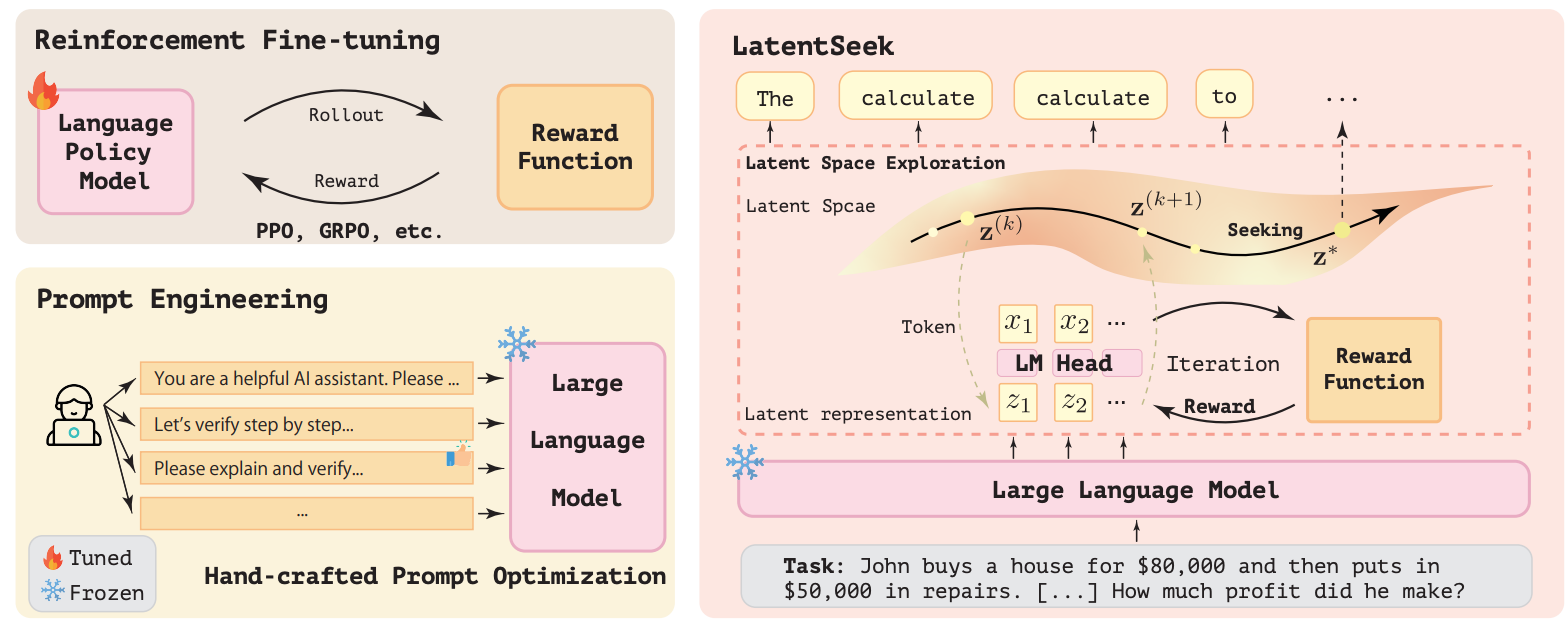
Test-Time Instance-Level Adaptation (TTIA)
problem formulation
auto-regressive language model $\pi$, a reasoning problem instance $c$ as context prompt: \(\pi(x|c) = \prod_{t=1}^{T} \pi(x_t | x_{<t}, c)\)
at test time, the ground truth is unknown, introduce a reward function $R(x, c)$: \(x^* = \argmax_x R(x, c)\)
TTIA with policy gradient in latent space
for a given input sequence $x$, denote a corresponding sequence of latent representations $z = (z_1, z_2, \cdots, z_T)$, where $z_t\in\mathbb{R}^d$ lies in the latent space of $x_t$, 这里说的是LM head之前的最后一层hidden state。
则TTIA in the latent space的优化目标如下: \(z^* = \argmax_z \mathbb{E}_{x\sim\pi(x|z)}[R(x, c)]\)
💭 comment: 这太奇怪了,这样language model只是encoder的作用?reasoning指望在这最后一层latent通过self modification完成?
- sampling strategy
- 像本来的模型一样,某个位置的latent只管那个位置的token
-
$\pi(x z) = \prod_{t=1}^T \pi(x_t z_t)$
- optimization procedure
- $z\leftarrow z+\eta \nabla_z \mathcal{J}(z)$
-
$\nabla_z\mathcal{J}(z) = \mathbb{E}_{x\sim\pi(x z)}[R(x, c)\nabla_z \log\pi(x z)]$
- reward function
- latent space $\rightarrow$ greedy decoding $\rightarrow$ self-reward prompt + pretrained language model $\rightarrow$ compute the reward
-
$R(x, c)\sim \pi(\cdot \tilde{x}, c, \text{prompt}_{\text{self-reward}})$
总体思想:用LLM的self-reward当reward function来优化最后一层的hidden state,像一个较为华丽的self-verification+self-consistency
performance
应该保持BoN和LATENTSEEK iteration数相同的: 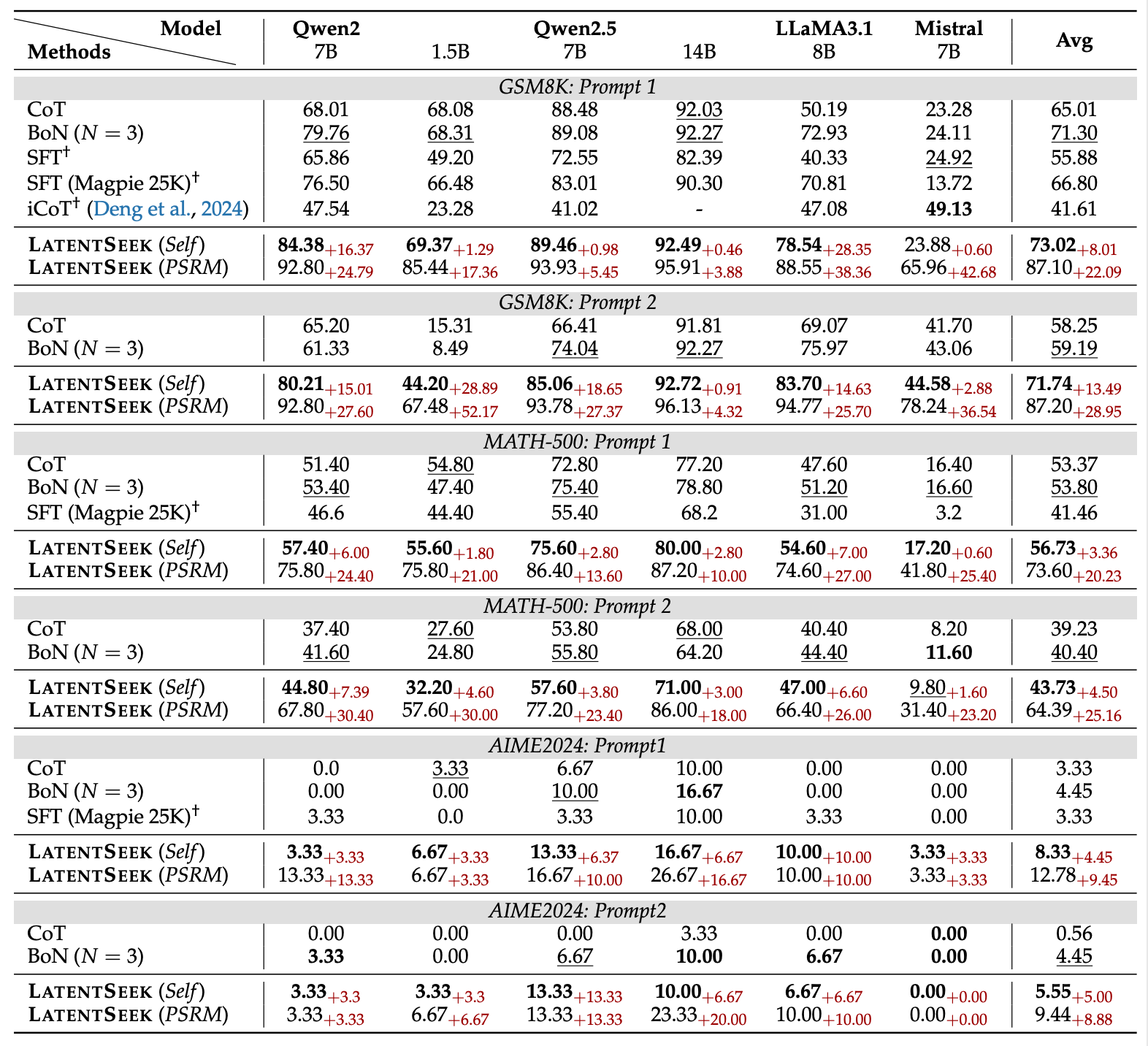
Hybrid Latent Reasoning via Reinforcement Learning
2025.5.24 UIUC
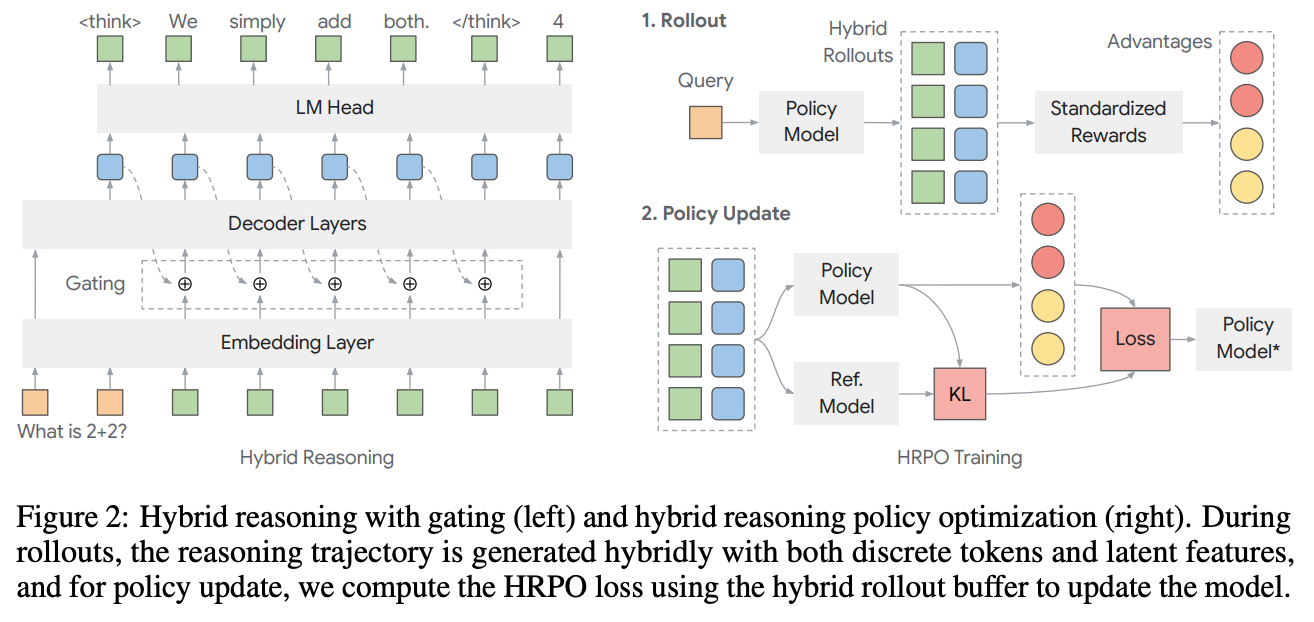
- introduce hybrid reasoning policy optimization (HRPO), an RL-based hybrid latent reasoning approach that
- (1) integrates prior hidden states into sampled tokens with a learnable gating mechanism
- (2) initializes training with predominantly token embeddings while progressively incorporating more hidden features
Methods
- 把最后一层hidden states对token embedding做加权和token embedding加起来,然后做正常的RL。
- 有一个gating机制决定hidden state和sampled token’s token embedding的占比
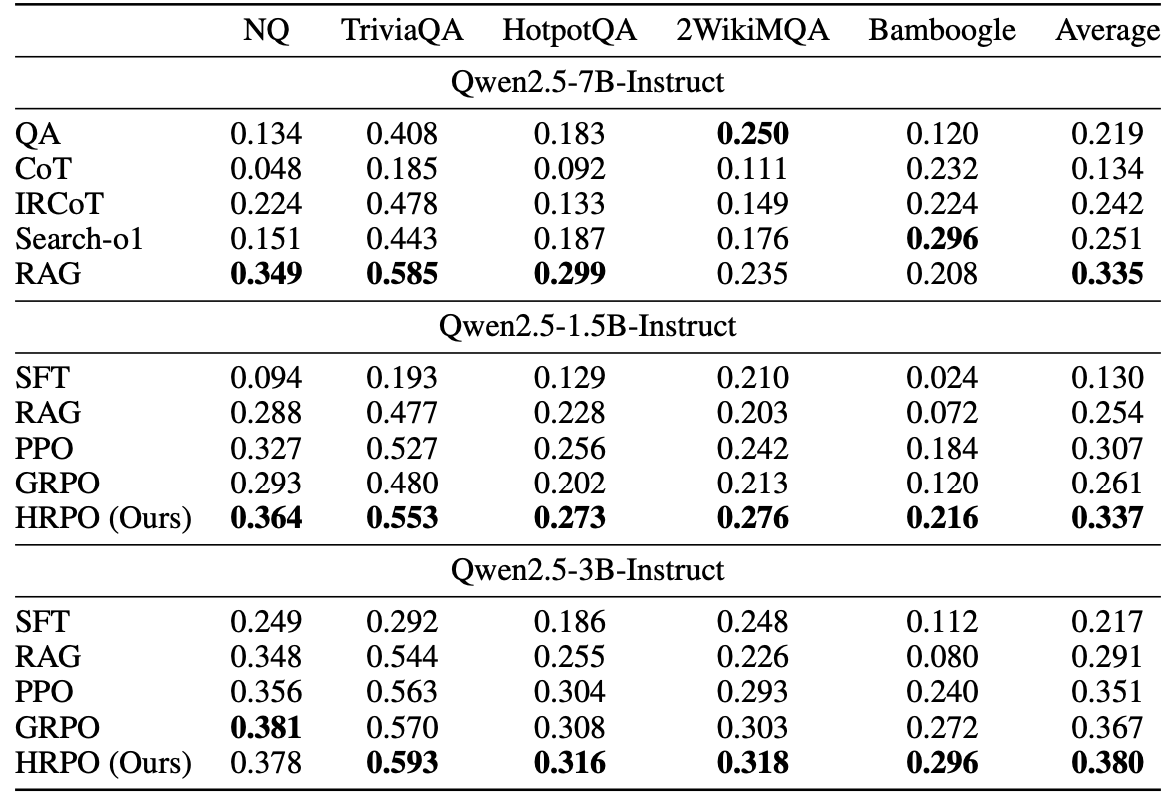
Performance
Reinforced Latent Reasoning for LLM-based Recommendation
- discuss applications in reconmmendation system
- two-stage strategy:
- first, supervised finetuning to initialize the latent reasoning module
- second, pure RL training to encourage exploration through a rule-based reward design
- add an attention layer on top of the LLM’s final decoding layer $\rightarrow$ extracts information from the final hidden states of the LLM to generate a latent reasoning token aligned with the LLM’s input embedding space
💭 为什么是一个attention层?
Latent reasoning architecture
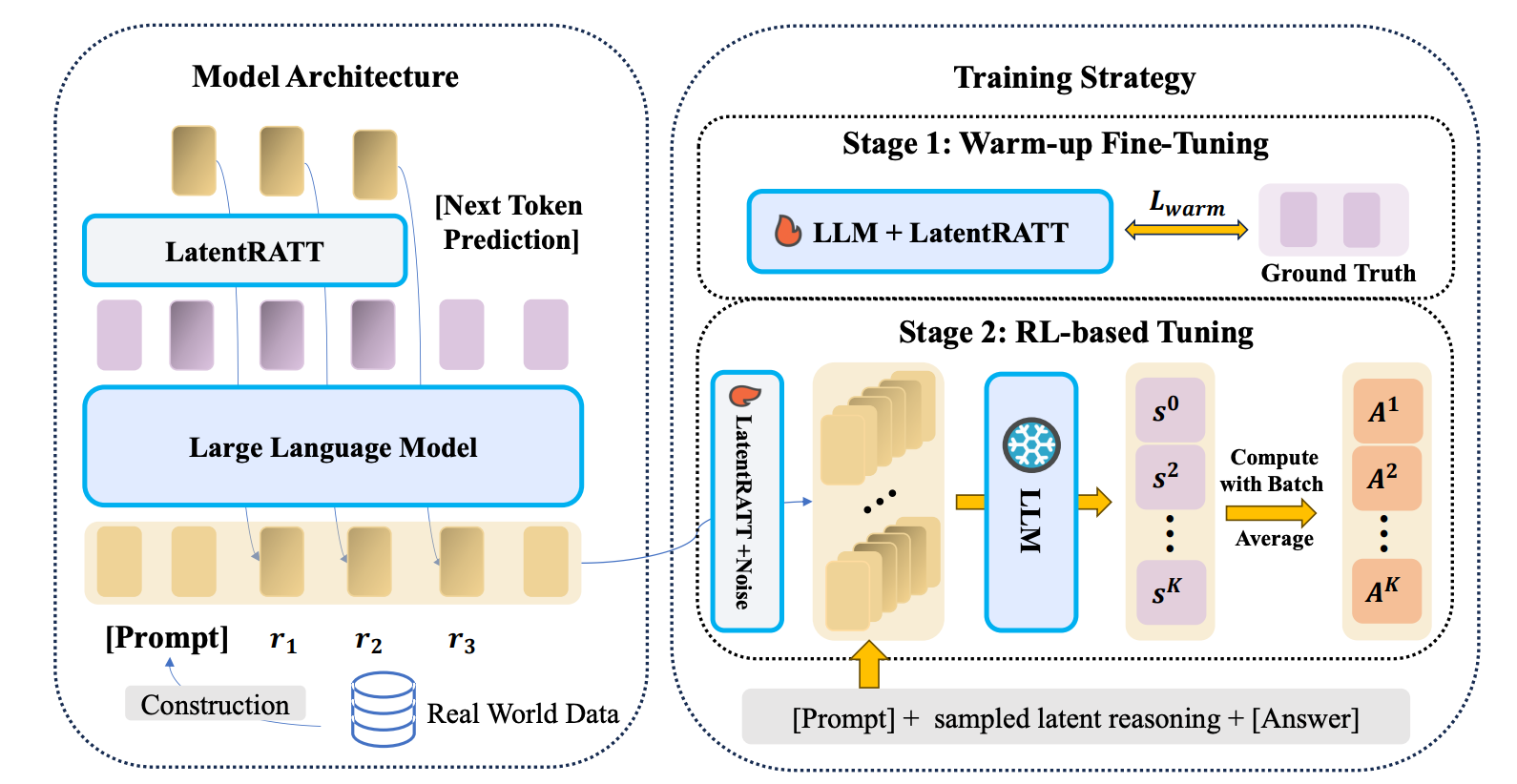
- introduce an additional attention layer on top of the final decoding layer to explicitly generate latent thought tokens
- dedicated reasoning generator that aggregates contextual information?
- ensure the generated tokens are aligned with the LLM’s input embedding space
- 定长latent token
 Continuous Chain of Thought Enables Parallel Exploration and Reasoning
- continuously-valued tokens (CoT2)
- examines the benefits of CoT2 through logical reasoning tasks that inherently require search capabilities
- provide optimization and exploration methods for CoT2
- interpretability
- CoT2 allows the model to track multiple traces in parallel and quantify its benefits for inference efficiency
- one layer transformer equipped with CoT2 can provably solve the combinatorial “subset sum problem”
- several sampling strategies:
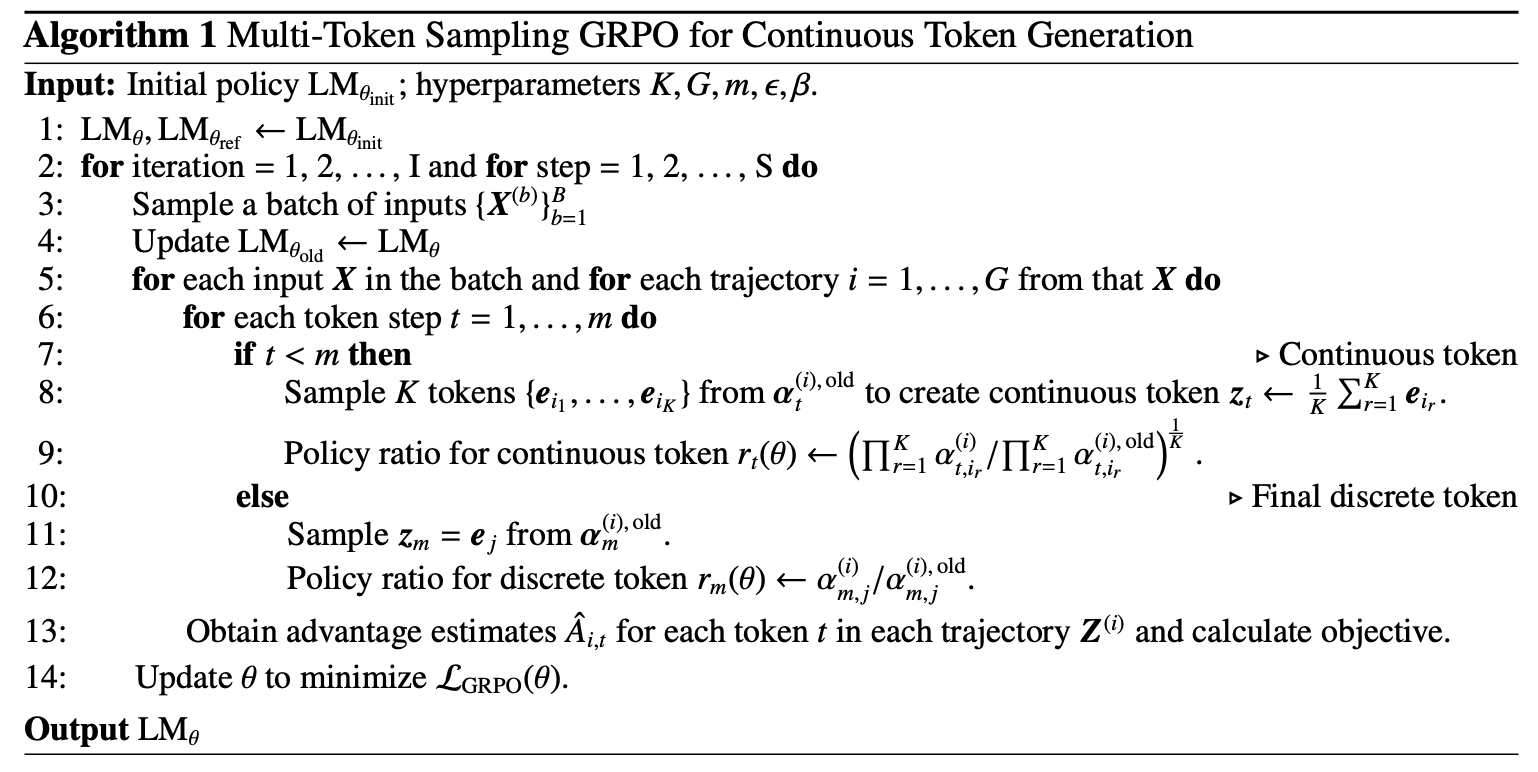
- samples and composes $K$ discrete tokens ar each decoding step to control the level of parallelism (reduce to standard CoT when $K=1$)
- continuous exploration over the probability simplex
- policy optimization with CoT2 indeed inproves the performance of the model beyond its initial discrete and continuous supervision
Introduction
Motivation:
- modern language models may not fully utilize their potential for a few reasons:
- discrete sampling of tokens limits the model to emitting at most $\log_2(v)$ ($v$ is the size of vocabulary) bits per sample, or more specifically, the Shannon entropy of the softmax output. This contrasts with the $O(d)$ bits each token embedding can store
- Secondly, discrete sampling can cause the model to commit to certain solutions and avoid exploring alternatives
Method: CoT with Continuous Tokens (CoT2), built on COCONUT
- rather than the model sampling a single token from the vocabulary, it samples or deterministically selects a continuous superposition of tokens according to the softmax output
Contributions:
- Mechanistic and theoretical study of CoT2
- theoretical: single-layer transformer can solve Minimum Non-Negative Sum (MNNS) using CoT2
- theoretical study for:
- Base CoT2: deterministic inference which creates and feeds continuous tokens using full softmax output at each step
- CoT2-MTS (multi-token sampling): samples $K$ discrete tokens from softmax and averages them to form a continuous token (maybe like top-k version of Base CoT2)
- Supervision and reinforcement for CoT2
- distill, like distill multiple CoT traces into CoT2 continuous tokens
- policy optimization
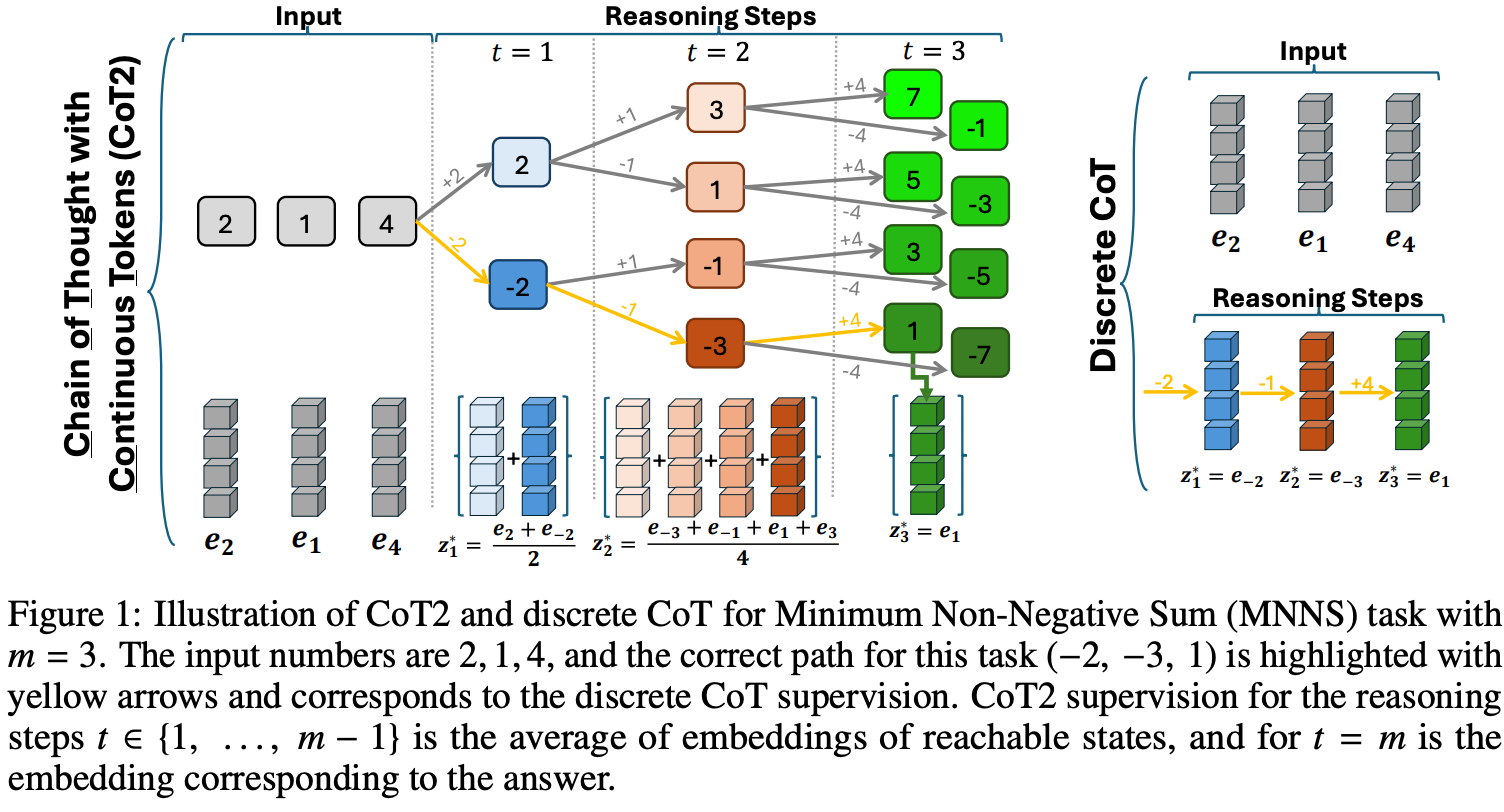
Problem Setup
Objective: given $X\in\mathbb{R}^{n\times d}$, where each of the $n$ rows is a d-dimensional embedding vector, the objective is to output $m$ tokens where the $m^{th}$ token to be the final answer.
除了final answer,前$m-1$个token均为continuous: For the first $m-1$ steps, the model outputs continuous tokens ${z_t}_{t\in [m-1]}$, at the final step $t=m$, the model outputs a discrete token $z_m$ from a vocabulary of size $v$.
对于$1\leq t\leq m-1$, the model outputs the following probability distribution over $v$ vocabulary entries via a softmax operation: \(LM_{\theta}(\cdot|z_{<t}, X):=\alpha_t\)
\[z_t = E^\top \alpha_t\in\mathbb{R}^d\]where $E$ is the embedding matrix $E = [e_1, \cdots, e_v]^\top\in \mathbb{R}^{v\times d}$
CSFT: A Supervised Training Method for CoT2
supervise at each token, specify a target probability distribution: \(\alpha_t^* = [\alpha_{t,1}^*, \cdots, \alpha_{t, v}^*]\)
train the model to minimize the cross entropy between model output and this distribution
2 ways to provide prefix:
- use ground truth prefix
- use previous generated continuous tokens
latent token数目固定
Reinforcement Learning Methods for CoT2
Think Silently, Think Fast: Dynamic Latent Compression of LLM Reasoning Chains
overview
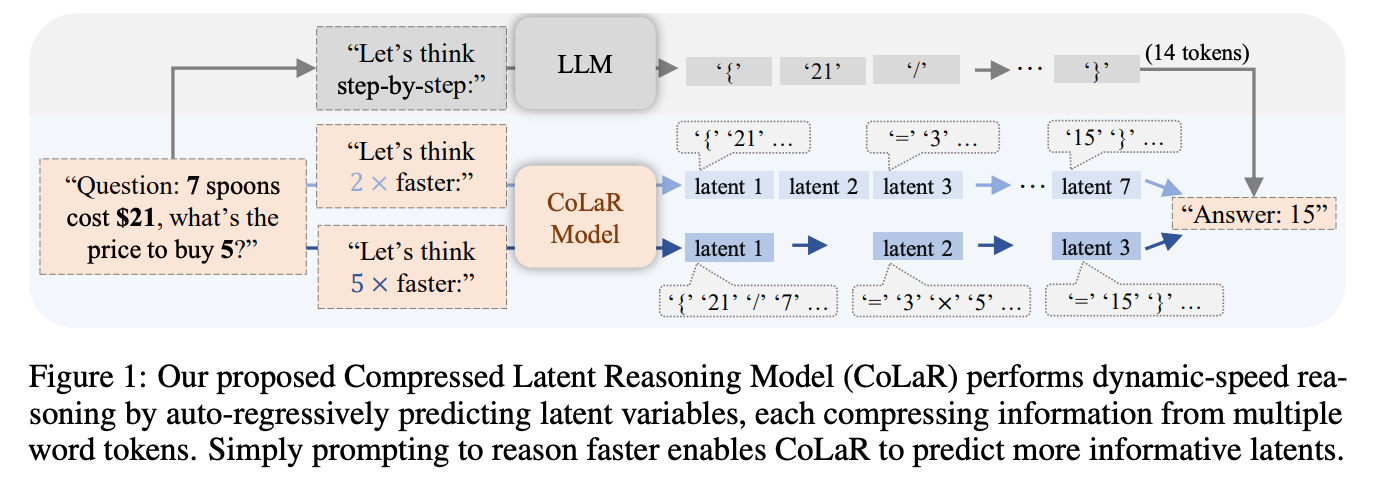
- 2-stage training approach
- SFT: next-token prediction by incorporating an auxiliary next compressed embedding prediction objective
- RL
- perform reasoning at a dense latent level; dynamically adjust reasoning speed
motivation regarding previous attempts
- regarding efficiency work about long-CoT
- enhancing efficiency at the token level, primarily by identifying and skipping less informative tokens
- prompting models to generate more concise reasoning steps
- dynamically terminating reasoning when the model exhibits high confidence in a trial answer
- regarding latent CoT
- Initial efforts attempt to “internalize” reasoning knowledge by curriculum learning or knowledge distillation
- Some works focus on the potential inside LLMs by looping or skipping some intermediate LLM layers
- Recent innovations have introduced auto-regressive prediction of latent representations for efficient reasoning ``` limitations:
- fixed-length reasoning chains
- use deterministic latent reasoning processes ```
method
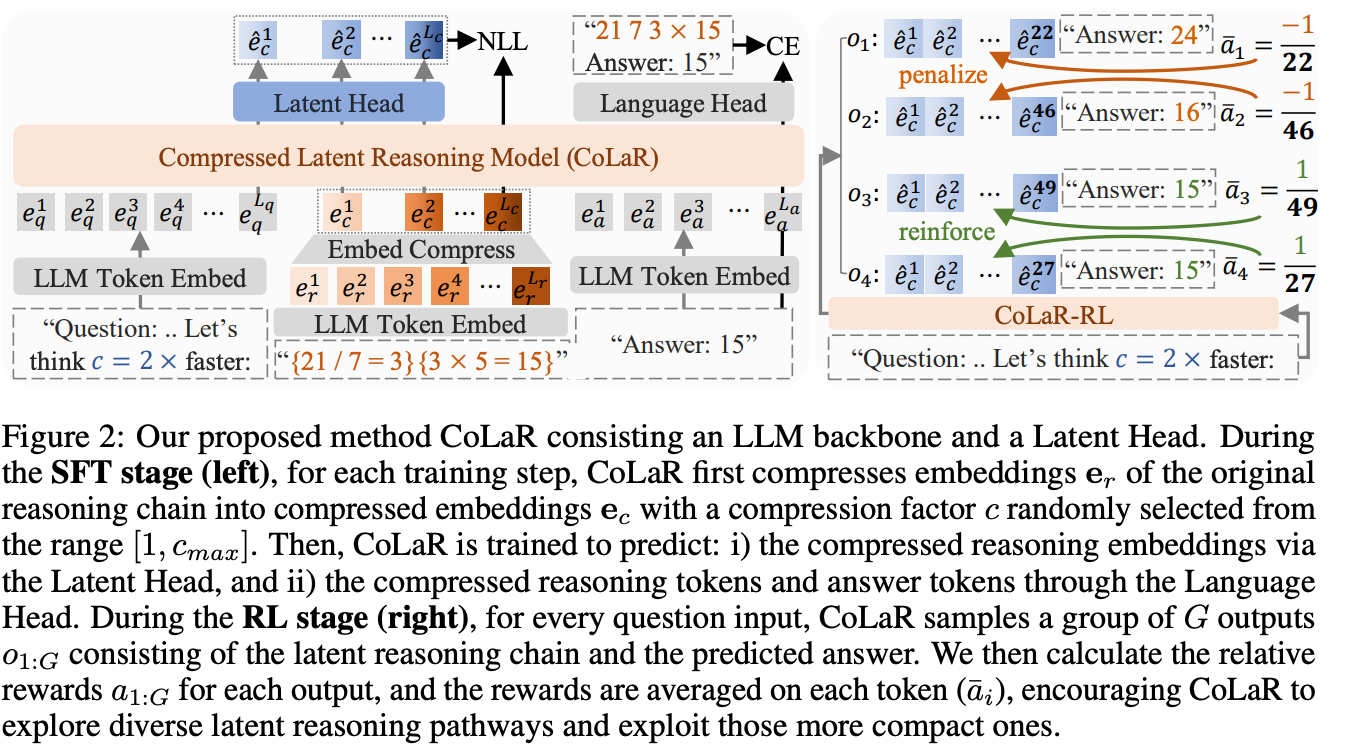
- utilize an auxiliary next compressed embedding prediction task in SFT stage
- at each training step, CoLaR first samples a random compression factor $c\in[1, c_{max}]$ and merges the embeddings of $c$
- Reasoning token compression and understanding
- 根据compression rate,begin each training step by randomly sampling $c\in[1, r_{max}]$, for every $r$ consecutive reasoning token embeddings $e_{r}^{k:k+r}$, the embedding compress module generates a compressed embedding $e_c^k$
- embedding compress module:
- apply mean pooling:
- Simply averaging these embeddings can distort the original distribution.
- For instance, consider two uncorrelated distributions $A\sim N(\mu, \sigma^2)$, $B\sim N(\mu, \sigma^2)$
- mean pooling would alter the original distribution to $\frac{A+B}{2}$, effectively scaling the variance by $\frac{1}{2}$. We found that, for most pre-trained LLMs, the distributions of embeddings are centered at $\mu\approx 0$. Thus, to prevent distortion of the original embedding distribution of LLMs, the Embedding Compress module only scales the sum of the $r$ embeddings by $\frac{1}{\sqrt{r}}$
- apply mean pooling:
- 怎么给loss
- 只通过answer来给不佳,监督太稀疏了没法收敛
- train一个model来predict compressed reasoning token, for each compressed token embedding, CoLaR should be able to read and predict tokens in groups of r. \(\mathcal{L}_{\text{comp}} = -\frac{1}{L_a+L_c}\sum\limits_{i=1}^{L_a+L_c} \log p([\textbf{t}_c, \textbf{t}_a]^i)\)
- Next compressed embedding prediction
- explore in the latent space $\rightarrow$ given the current hidden states $h_c^i$ output by $\mathcal{M}$, the latent head $\mathcal{E}$ predicts both the mean $\mu_c^{i+1}$ and the standard deviation $\sigma_c^{i+1}$ of the next embedding’s distribution $\rightarrow$ $e_c^{i+1}=\mu_c^{i+1}+\sigma_c^{i+1}\epsilon$
-
the latent head is primarily trained using the negative log-likelihood loss, for a prediction at position $i$, this can be formulated as: \(\mathcal{L}_{\text{latent}}(i) = -\log p(e_c^i|\mu_c^i, \sigma_c^i) = \frac{(e_c^i-\mu_c^i)^2}{2\sigma_c^i}+\log \sigma_c^i\)
- we empirically found that CoLaR with NLL loss tends to under-fit on simpler math reasoning datasets that require less exploration $\rightarrow$ propose a soft-MSE loss that combines Mean Squared Error with an entropy regularization term \(\mathcal{L}_{\text{latent}}(i) = \mathbb{E}_\epsilon [(\mu_c^i+\sigma_c^i \epsilon -e_c^i)^2] - \alpha \left(\frac{1}{2}\log (2\pi e (\sigma_c^i)^2)\right)\)
- Exploration with reinforcement learning
- use GRPO
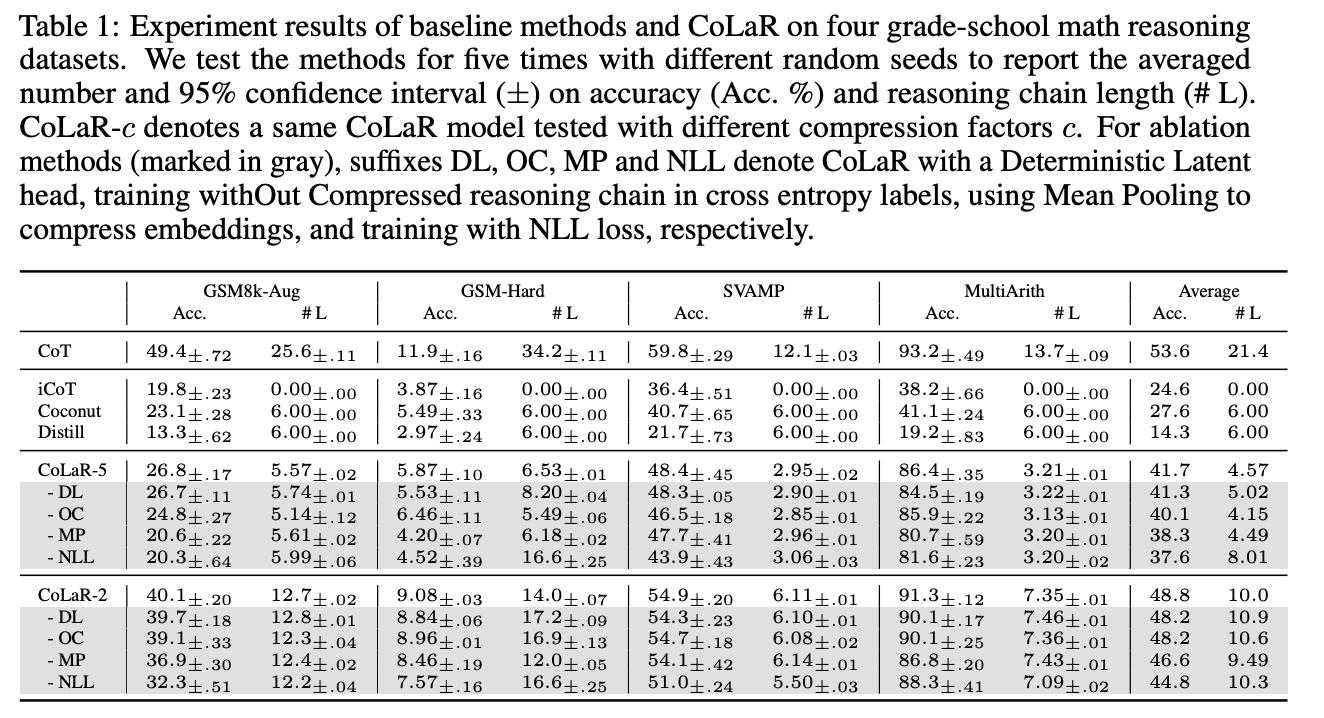
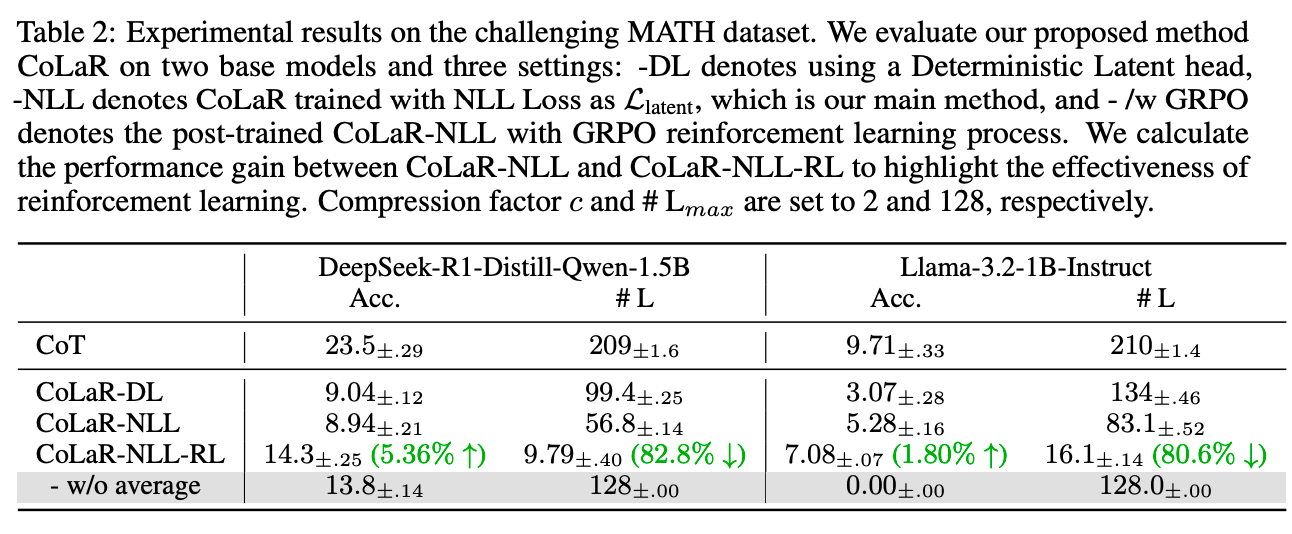
Performance
- use Llama-3.2-1B
Enjoy Reading This Article?
Here are some more articles you might like to read next: